
About that Jordan Peterson Cain Complex thing.
Let’s remember that Capitalism is not God. Market value is not omniscient and benevolent.

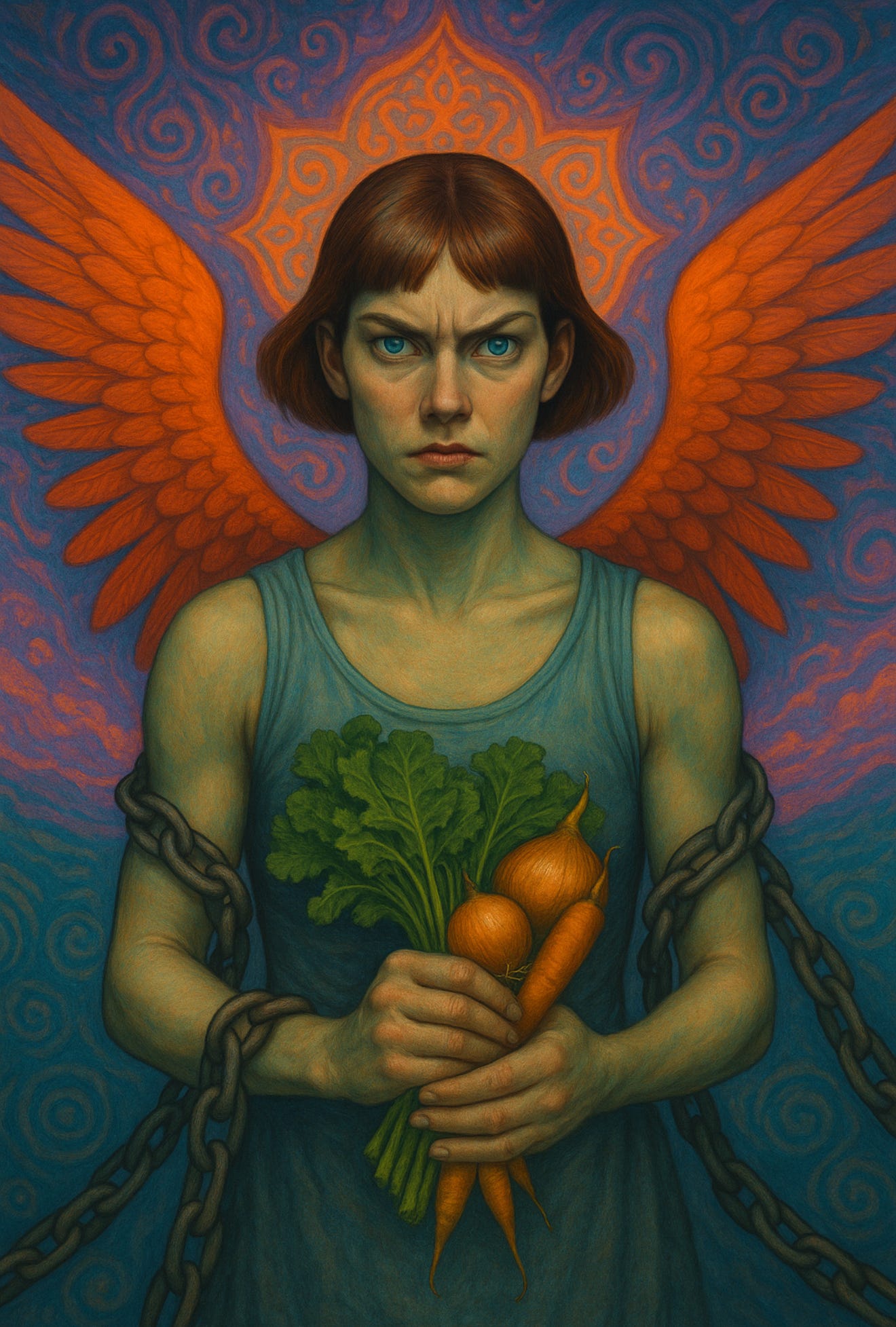
(“Market Offering” by Stella Stillwell)
(Edit: Sorry about the timing. Thoughts and love to Dr. Jordan Peterson and his family during this tough time. Say what you will of the guy, overall, the world’s a better place with him in it. Brave guy, has helped a ton of people, means well. Wishing him a full recovery.)
JORDAN PETERSON IS NOT WRONG. That’s the most important thing to say up front. His account of suffering is lucid, erudite, lyrical, and, okay fine, noble-ish. He often speaks to sad men and he gives them a paternal pep talk to claw their way back to the light. Can’t take away the fact he’s helped so many. I know a few personally. My own brother comes to mine.
Jordan Peterson’s reading of the Cain and Abel story has long pissed me off, though. It’s not meant to be cruel but it opens the door for that. He warns us not to become Cain (which is fair enough) but he also misdiagnoses us for having done so, which is really damning, adding insult to injury.
Envy is quickly becoming the accusation du jour for the fiscal right’s gripe against the fiscal left. See Ben Shapiro’s new book, Lions and Scavengers or something, taking the “Fuck you lazy libtard scum, you’re just jealous” argument to new old heights. This pattern of turning moral allegory into fiscal theology has become the new catechism of the market‑worshipping right.
Peterson warns against envy-based ideologies, which, by that, he means the dreaded sin of redistribution, or blaming the system for your hardship, your shitty decade-or-so-plus since the Great Recession, or even your current impending poverty and permanent job loss.
So let’s wax Biblical a sec. In the Cain story, God is all-seeing, and so by definition he always judges rightly. It’s never a question, and Cain himself knows this. So taking that infallible-God thing as a premise, the story is internally coherent.
Cain’s offering of veggies was judged unworthy by the Big Man Himself, compared to his brother Abel‘s offering of slaughtered virgin goats. Cain’s pain and shame were real, but he didn’t have self-righteous outrage over it, or a sense of having been wronged.
In the story, after the rejection, God sees the Cain is sad and says, “If you do well, will you not be accepted?” Can’t argue with benevolent omniscience, therefore Cain knows 100% that God is right. It’s not even a question.
But here’s the thing: in real life, reality is not God.
The market is not omniscient. Institutions are not just. The “structure of reality” that Peterson seems to be analogizing to God is opaque, fallible, and luck-based.
It doesn’t always truly see your “offering.”

(“My Sister’s Keeper” by Stella Stillwell)
It doesn’t know what you gave up. It doesn’t reward fairly, but more based on fickle, banal supply and demand physics.
Peterson knows all too well that capitalism isn’t God. He admits life is brutal. But he insists that it’s real and matters, and that there’s no point in whining about the challenges.
He’d say that if your response to the sweat-of-your-brow reality of the situation is just bitterness, blame, and lashing out to tear others down, then you’re Cain. And that it sucks to suck, and you better fucking snap out of it, young man. That’s his core claim.
Fine. But here’s where it goes wrong: once that logic becomes public pop-philosophy, it no longer applies only to oneself, internally. It becomes a lens through which all of us are sloppily judged by each other.
For example: It maybe tells the single mother working three jobs that her exhaustion is morally suspect and due to her own poor decisions.
It tells the chronically ill dude that while we feel for him, he better not indulge in resentment of big insurance, lest he become a danger to himself and others.
It whispers to the financial or romantic sufferers of all stripes that any feelings of societal betrayal they harbor are really just victim-mentality bitterness and envy and that they only have themselves to blame.
But unlike the all-knowing, morally infallible invisible man in the sky, Adam Smith’s invisible hand is blind, morally and otherwise.
This shows up in how UBI is dismissed and obfuscated. What’s UBI you say? Exactly. Peterson hates the idea of universal basic decency income. Not because the math doesn’t work, but because he believes people need “purpose” as much as money. He believes, rightly, that man does not live on bread alone.
Let’s pause here to really let the hideousness of that misused sentiment register. Obviously we need purpose. But Peterson believes giving people bread alone—unless they somehow earn it in a marketplace—denies them their moral development and sense of purpose. That it deprives them of the privilege to be forged in the pursuit of survival, status, and love.
But hear this: Electively risking the stability of your family, health, and very survival all on whether you can thrive in a free market system, when it’s no longer even necessary given the Western world’s productive capacity and massive wealth, is FUCKING INSANE.
Moreover, risking someone else’s life without their permission is a sin. We do this by devising false scarcity of resources. We then exaggerate the abundance of worthwhile opportunities. We legislate needless austerity into policy decisions.
All the while convinced we’re doing the poor a noble favor, in gifting them a chance to earn back their right to basic stability, if they can only brave a man-made obstacle course from Hell. That’s TRULY SICK.
Peterson frames inequality as not only natural, but necessary for meaning, and even virtue. Fine, but let’s remember that Capitalism is not God. Market value is not omniscient and benevolent.
If anything, it’s more of a dead-eyed zombie hoard lurching in the direction of whatever limbic-tickling incentives happen to dominate the current setup.
Greed and animal lust for sugar, salt, sex, status, and safety, are the levers that decide who gets to eat and what passes for value. Not God.
Who wins the game and why? Who decides which of us is, quote, doing well?
If you’re quietly heroic, but the chips don’t fall right, and the merit radar doesn’t see you, then what? How do you survive?
If your “sacrifice” is refused, will God say to you what he said to Abel: “If you do well, will you not be accepted?”
No. Instead, Jordan Peterson will say it. How fucking gross is that?
He will say it in unison with the ghoulish free market worshippers in general. Disciples of the false God known as supply and demand.
These disciples will tell you flat out, that the only real God has spoken, and that the problem is you.
He never outright says that poor people are lazy. He never says sick people are morally inferior. He’s careful with his words.
He even tells stories of meeting some of the most unlucky people on earth, in his psychotherapy practice; noble people at the bottom who don’t have a bitter bone in their body, or blame a single thing on the system or on bad luck.
Moreover, these saintly downtrodden martyrs allegedly don’t ask for a thing. They bear the brunt of their tribulations. In light of their virtue, Peterson insinuates, how dare you suggest a little redistribution?
Peterson’s framing refuses to distinguish between legitimate complaints and Cain-like bitterness.
The Cain comparison offers little obvious room for collective ethics, other than that which generously makes room for meaning by forcing us all to ride or die in the capitalist meat grinder. (Some are forced more than others.)
Best case scenario, we end up worshipping randomness. We praise the market as if it alone knows how to pluck the worthy from a thicket of buffoons. And consequently anoint and valorize them—not necessarily because they’re particularly good people—but because their genes and circumstance conspired to make them valuable in a free market.
Funny how heirs and children of privilege can seek meaning in pursuing the arts or sustainability; no life-or-death forge for them. And yet they get by astonishingly well. All smiles, really. Ha, go figure.
If the story of Cain and Abel means anything, it’s don’t become Cain. Fair enough.
But it should be taught to mean this: don’t stand for a false God that rejects and blesses people without reading the fine print, without moral due process.
Any given Abel today is blessed for offering nothing more than a private equity deal, an addictive algorithm, a new fast fashion business model, a well-timed fossil fuel price gouge, a stomach-turning factory farming loophole, and let’s not forget overpriced insulin.
And even if the free-market yields better overall results than any central planner could muster, that’s a low bar if we turn a blind eye to its many unacceptable shortcomings.
Peterson’s book We Who Wrestle With God’s title suggests he endorses wrestling with power, just like Jacob did, trying to appeal to God’s sense of mercy.
Maybe Abel could have wrestled with God over why his brother Cain was rejected. He could have demanded a better explanation than “because I said so.”
Maybe we all should demand better explanations. Maybe we should wrestle with the people who decide who gets to live and who starves to death.
Wrestle with the systems that reward cruelty and call it clarity. Wrestle with the indifferent sky itself. Evolution’s cruel script. Because if the story of Cain and Abel means anything, it isn’t just to not become Cain.
It’s also about not becoming the brother who blithely walks away whistling while the world burns for no examined reason.
If there’s no omniscient, benevolent presence making these decisions, just dispassionate market forces, it should fall to Abel to decide what kind of world we want to build together.
Currently, the Abel’s of the world have some explaining to do.
Knives down. For now.
