
Chords of Justice
An observation about the layered, piquant writing of musician Peter Himmelman, and that of artists in general.

Lately I’ve been struck by Peter Himmelman, not just his music at the moment, but his varied writing on Substack. The way he speaks about the world. There’s something in it that feels like a composer is trying to talk about justice, or faith, or the inner life, but thru a sort of musical sensibility.

(“Blue Girl” by Stella Stillwell)
Not just because it’s lyrical and metered and devastating, like a good song, which it usually is, but because it’s shaped by the way music teaches you to meet messy things halfway, by reaching for the more precise feeling instead of reducing life to something overly simple.
To bring this down to earth for a sec, think how resolution works. In music, we crave it, as humans. It’s biological. But the best composers don’t just indulge that craving, they tease it, delay it, or swap it out in a novel way. Chopin comes to mind. Bach did this all the time. So did the Beatles.
But then take a Zappa or Eno, or even an atonal Webern, or Schoenberg, or even just a sophisticated jazzer.
They make you stretch your ear even more until what once felt like dissonance starts to feel like truth, and then, eventually, beauty. Not because the resolution isn’t there, but because you’ve changed enough to hear it, to accept it on its terms. To see yourself in it and integrate that into the picture of the world, yourself, and how we regard others, the people we love and those we hate. Ideally the hate is transmuted into understanding, in the way a dissonant chord eventually sounds gorgeous, or at least essential.
All this feels connected to how we think about justice. Especially these days where blame feels like a dominant chord pulling us, yanking us sometimes, toward something that feels like inevitable closure.
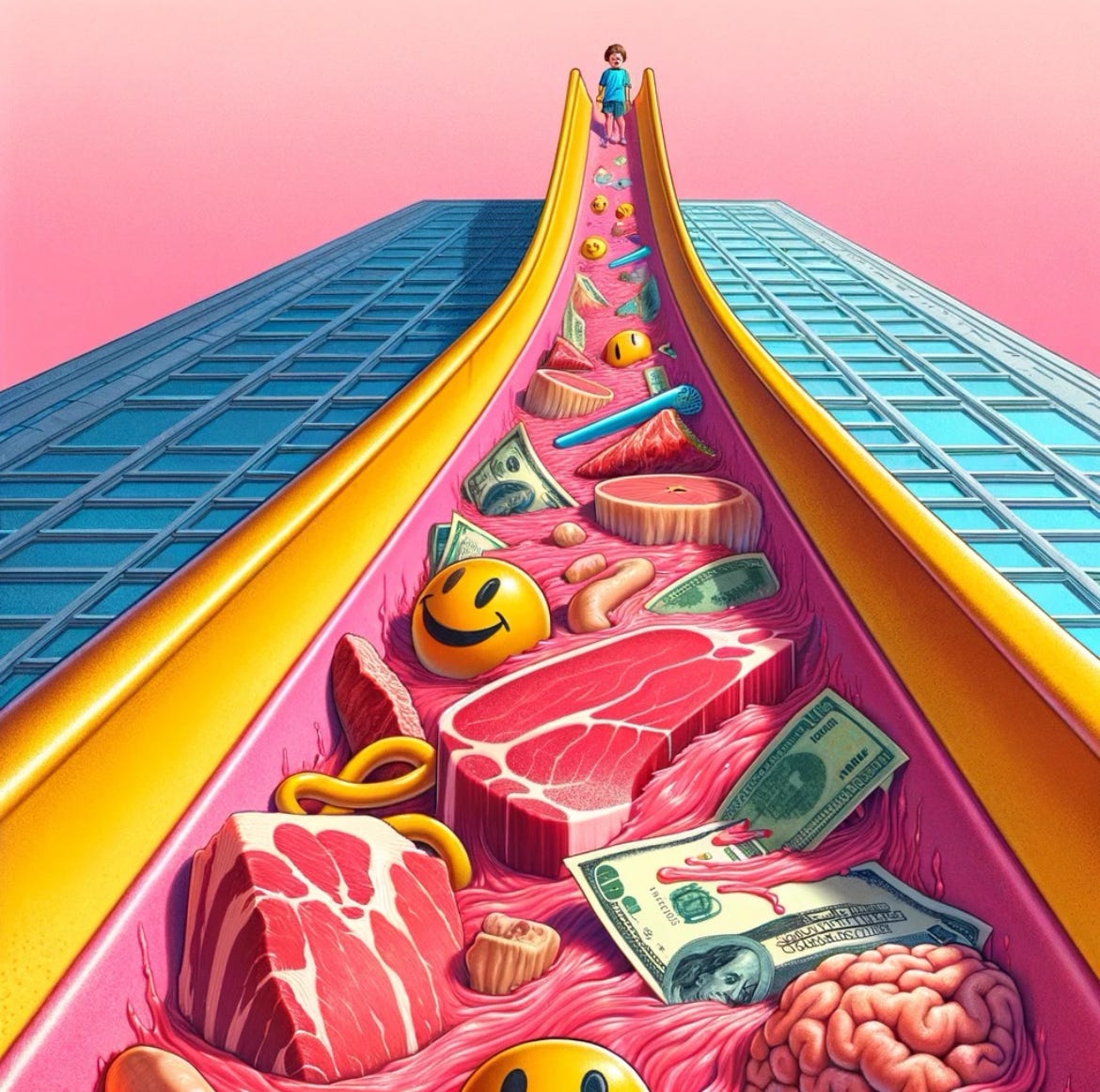
(“Slide” by Stella Stillwell)
But maybe not every harm needs a tonic. Maybe not every pain needs to be answered with punishment or ridicule or outrage. Maybe we’re meant to expand the palette, like moving from a 1–4–5 into something richer, something less digestible to the common denominator but more honest, more precise.
Comedians feel this too. The good ones, at least. They can’t fake it. If they get it wrong, the body doesn’t laugh. That makes them moral instruments in a way philosophers often aren’t.
You can say something that sounds profound and get applause, but to get laughter you have to touch something true.
Same goes for music, at least for me. Which is why I’ve learned to fear the most popular stuff like I fear fast food.
Same goes for anything that lives in the body before it climbs into language. Paintings. Stories. Dance. Acting. Sculpture. Maybe even a good sermon from a rabbi that gets you to see the real reason we do this or that, instead of the tonic-dominant reason we were taught in Sunday school.
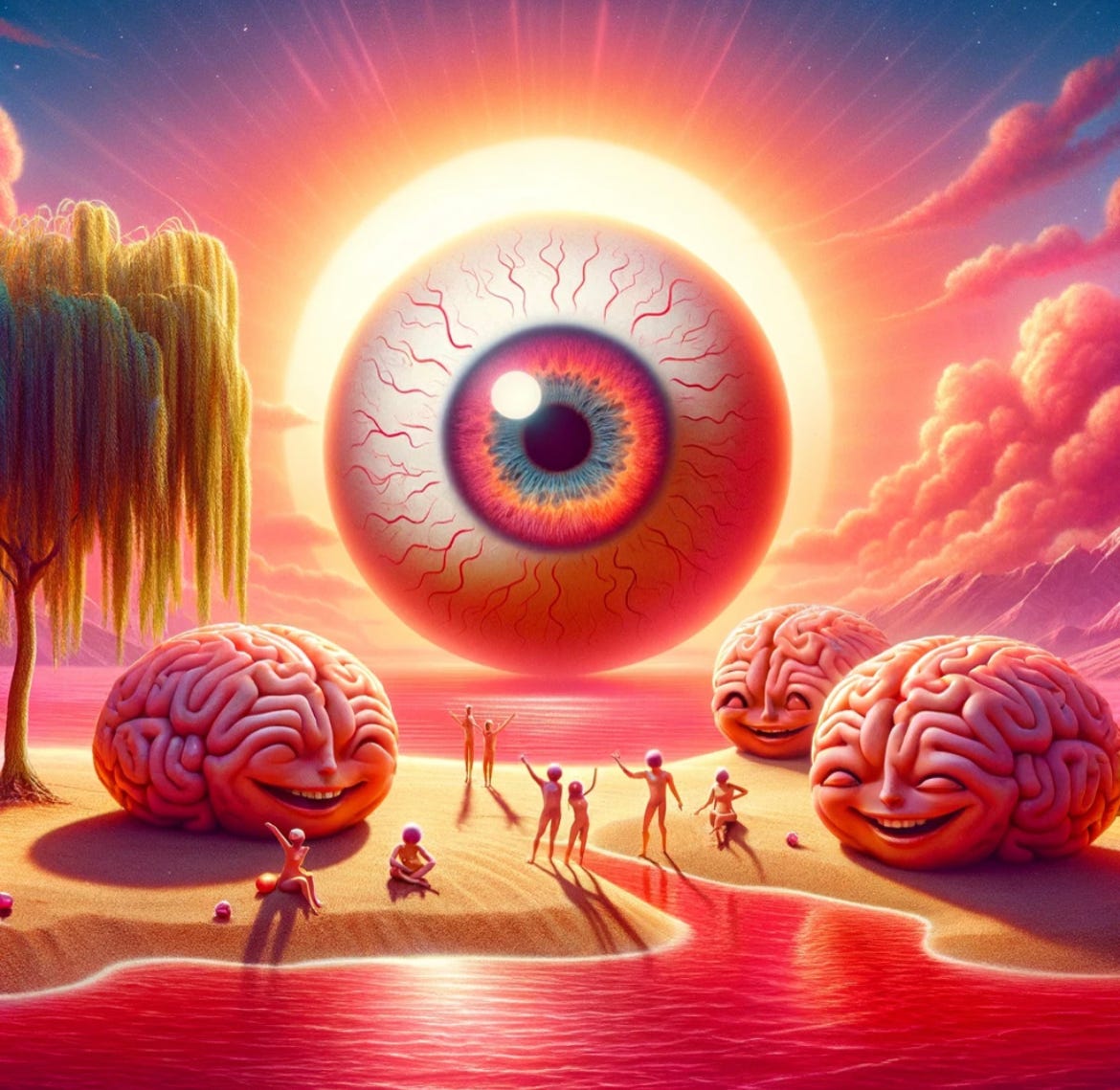
(“Beaches in Pinks and Peaches” by Stella Stillwell)
There are subs I read to watch people perform certainty. And then there are the ones I pay for. The ones trying to listen to reality, not just annotate it. You can hear the difference. It’s the same as the difference between a verse designed to sell and a verse that’s daring you to remember your own rough edges. (Praise the Lord when they do both.)
Populism, in this sense, is just musical conservatism. It trusts 1–4–5 and looks sideways at anything unfamiliar. A minor iv instead of a major V is too precious. A flat VI instead of the V is pretentious. Diminished? God forbid.
But when politics becomes afraid of Beatle chords, it starts to sound like a jingle. Market-safe, inoffensive, and empty. And when moral reasoning follows that same path, we lose access to the parts of ourselves that don’t fit inside a clean resolution.
Himmelman can’t help but write like his chord choices. His inventive phrasings. Not to mention his loyalty to his Jewish values and identity even if it costs him mass acceptance.
Sometimes we need a cadence. Sometimes we need to get inventive in a roundabout way like Mozart or Bach. (I’ve heard every unexpected Beatles chord buried in those old-timey compendiums.)
We need the tools to do both. That’s what really good songwriters know. Not just popular ones. Good ones. That’s what composers usually know unless they are just making wallpaper.

(“Pillared Hallways of Guf” by Stella Stillwell)
And maybe that’s the shape I want justice to take, to grow past punishment into something stranger, quieter, and more tuned to the full range of human experience.
The world demands a dominant-tonic resolution. Fight back. Answer with a twist. Take a sad song and make it better.
(Artwork by me, apropos of little, generated from prompts taken from this piece.)
Here’s a killer piece by Peter Himmelman that really cut thru the noise.
