

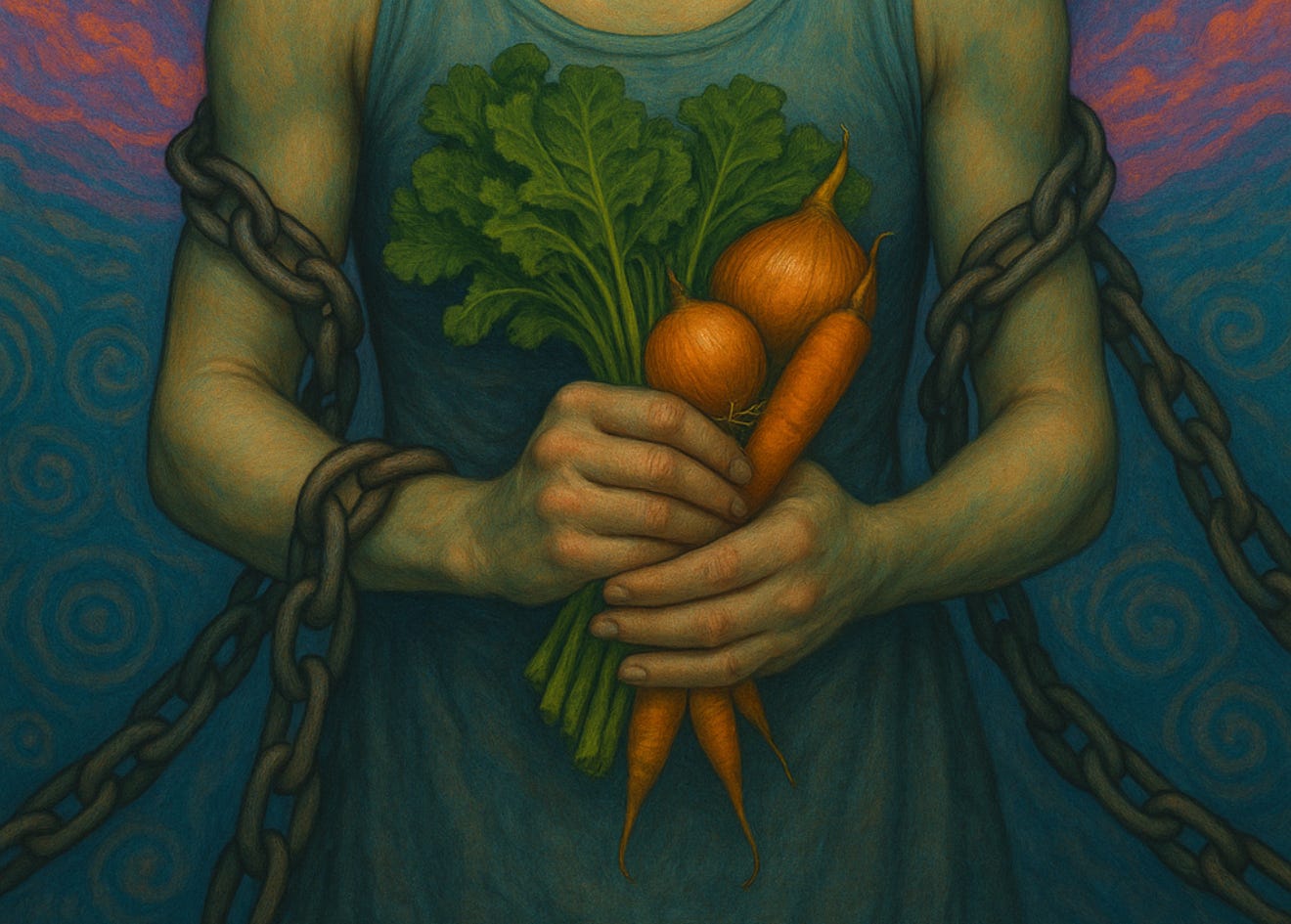
FOREWORD (is forewarned):
I’ve spent a long time watching people argue about what’s right. Philosophers, theologians, scientists, skeptics, and everyone’s offering their angle on what we should do, or why we should care. I don’t have much patience for it anymore. Not because I don’t care, but because I do. i care enough to want something that fucking works.
For me, everything starts with experience. What it feels like to be alive. To hurt, to feel good, to witness suffering and want it to stop. It’s like something to be this way. Likism. There’s something in us when we’re not too broken or numb that leans toward helping, toward easing pain, toward making things better. I call that IWRS: Increase Wellbeing, Reduce Suffering. No not everyone has it. Some do. So this isn’t a war of who is right, but a war of who gets to decide what right IS. What is the meaning of ought, and what is the only “ought worth wanting.” Worthwantism.
It’s not a theory I need you to believe in, just a description of what happens when your empathy collides with post-reflective clarity and coherence.
The challenge really isn’t persuading each other through arguments, although I get the impulse. It’s figuring out how to protect and scale the capacity to care at all. That’s a biology war mostly. It starts at brain chemistry, neural wiring, stress environments, developmental windows. It’s wrapped up in culture and tech and incentives in weird ways. If we don’t scientize this tangle of shit now, we’ll keep watching cruelty repeat and multiply, no matter how clever our ideas sound, and we will DIE mid argument.
I wrote three pieces (at least) to try and name what I see. Not to dictate a path, but to offer one that feels honest, and I want you to be honest in return and tell me where it fails. I’m going to err on assuming there’s a filter that ends species that get as far as we have. My goal is to have humanity survive it. This is what I have. Enjoy. Help.
—Stella Stillwell, to the human family of Earth. I’ll never stop reaching for you in the dust.
Before We Begin, A Word About Cain’s Offering
I’m not sure why almost everyone I know seems to want a mini castle filled with expensive crap.
Abel’s offering comes to mind: “The firstlings of the flock and the fat thereof.”
Cain, by contrast, brought the fruit of the ground. (Veggies?) Modest. Honest. Unadorned.
His offering wasn’t wrong, per se, it was just unrecognized. And maybe that’s what broke him.
Cain the murderer was wrong. But I’m focusing on Cain the potentially misunderstood. The one who brought what he had, from the soil he worked, and got silence in return.
Of course, the God character in that story is presumed omniscient and benevolent, so the lesson should be interpreted in that light. There’s plenty of great wisdom in that story and other biblical parables.
But too often we use that particular story to swap in the free market for God and create a Just World Fallacy and admonishments about envy and victim mentalities. The ones being blamed today by markets that are neither benevolent nor omniscient are the “Cains” I’m talking about. I’ve railed about that elsewhere. Enough about that for now. Here’s a different story.
I AWOKE TO THE SOUND of cold rain, under a warm blanket, under a strong roof, and time to lay in. No work today.
All I need is my phone and some coffee and I’m gold. The coziness factor is turned up to eleven. Modest joy. Quiet plenty.
There are healthy calories a dozen steps away. Indoor plumbing with, get this, HOT water. If something horrible happens, professionally trained strangers will come save me within 5 minutes.
I can look at any book, documentary, movie, song, painting, ever made, communicate with any type of person on any sort of topic. I can create, explore, share, grow.
Outside my door are miles of paths to walk, trees to see and touch, sky to behold, and thousands of reasonably kind, sane people who also have all this, many of whom I haven’t met and are just a “hello” and a smile away.
Should I want a particular thing, for fun, health, hygiene, or whatever, it’s available very quickly, at very low cost.
I have everything a sane person could need.
There is only one thing left to be bothered about: the needless suffering of living things that share my planet and who are in reach of help if only we had the will to give it.
Some are sentient, can feel pain and well-being, and some are even sapient, can suffer in that vast human way that gives Hell quarter in short stints.
Life is finite but feels infinite when you’re living it, especially when in prolonged agony.
A friend asks, “How do we know agony is bad?” I pause to reflect.
Surely I’m confused: we know that unnecessary pain is bad because we can feel it directly.
It is literally that which we tend away from without an additional reason.
The word “valence” comes to mind.
Negative valence of suffering is a self-evident “booooo.”
But my friend persists: “Yes, but how do we know inflicting pain is bad or wrong?”
Again, I pause to reflect.
Why would I need to know such a thing? I have seen others in pain. I’ve seen others writhe in agony, physical and emotional. Whenever I see this, it hurts me, too. I feel it in my mirror neurons, the ache deep in my chest, my soul; and my body is flooded with chemicals that impel me to help.
“I am wired to find the pain and agony of others repellant. WE are wired to hate the pain of others,” I say. “And we now know better than ever what makes humans hurt and how to relieve it.”
The neuroscience of well-being is revealing. Sure, some pain is part of life, but if you grant that such a thing as unnecessary pain exists, we should be trying to alleviate it where we can, as long as it doesn’t break society or make things worse somewhere else.
“So we should relieve it. We will. We are already. Some of us anyway. More would if we got good at talking about this and organized better.”
My friend says nothing.
“Right?” I ask.
Silence.
“…Right?”
Somewhere in the slow drizzle, in the sound of wet steps on pavement, there’s an answer.
I strain to understand what my friend feels in this moment.
I worry I’ve made them feel guilty or judged.
Perhaps they’re not wired to hurt, to experience negative valence, in quite the same register I am, when beholding the agony of another.
Or perhaps they ARE wired that way, but only for people or animals they know, or like.
Maybe some of us only have that instinct for our own tribe, and are able to blunt that empathic pain-response when it pertains to outsiders.
I can sort of imagine why this would be the case. Too much empathy for a competing tribe might leave an opening for your tribe to be slaughtered.
Maybe those of us who too easily feel the needless agony of others, and process it as self-evidently undesirable and something to reduce as soon as is feasible, DIED OUT.
Maybe we were once a liability to our tribe.
Are we still a liability? Now? With the coziness factor turned up to eleven on a 3k-a-month salary?
I wonder.
I don’t think so.
Maybe that’s why we are now walking in silence. Me, and God, and whoever still thinks an offering of vegetables shouldn’t be scoffed at so quickly by people who mistake free market efficiency for a God that gets to decide who receives blessings.
▪️
Below, find the 10-point Stillwell Derivation for IWRS (Increase Wellbeing Reduce Suffering).
First, read What This Is, What This is Not, then the framework itself, followed by Where This Leads.
PLEASE COMMENT once you’ve had a chance to digest. Your feedback is extremely appreciated and will help sharpen the way these ideas will be presented. Any comments — pro or con — will be met with good will. ❤️
What This Is
A step-by-step construction of normative weight, built from the fact that experience exists and suffering hurts. It’s not a framework you adopt. It’s a series of facts you either recognize or resist.
What emerges is IWRS (Increase Wellbeing, Reduce Suffering) as the only non-arbitrary ethical direction available to conscious, sentient, empathic human agents reasoning with coherence.
No divine command here. No metaphysical leaps. Just phenomenology, valence, empathy, and reason.
Think of it only as a normative reckoning that begins within direct experience and extends outward through coherence.
IWRS might resemble moral realism because it predicts what people will inevitably do when trying to reduce suffering and succeeding. But prediction is not prescription. If it starts to feel like moral “rules” just remember that I’m trying (and perhaps failing at times) to make this behavior more analogous to gravity:
If an object is in the field, it falls. If it isn’t, it doesn’t apply.
If you’re wired for the more common form of human-like empathy and coherence, you’re already downstream. If you’re outside this norm, the system doesn’t apply. That’s okay. It’s not a moral judgment, just treated as a scope condition for now.
What This Is Not
Nothing in the 10-stage system should be taken as a moral claim. Not asserting stance-independent moral truths. Not saying IWRS is “right” in some cosmic sense.
This isn’t moral realism. Not assuming universal moral facts. Also not appealing to moral desert, divine law, blame, or earned praise.
No moral claims. Just AESTHETIC claims, rooted in the felt valence of experience, and the observed patterns of attraction and repulsion that often happen when we humans are exposed to pain, clarity, and each other.
It loosely maps the behavioral gravity that pulls minds toward reducing suffering, when they’re wired to care and running clean.
It uses one wiring scenario:
Pain is real and, by definition, undesired
Empathy transmits valence across identity boundaries
Coherence impels action once pain is perceived
That’s all! No “ought.” (Yet.) Just outcome.
If that wiring isn’t present, the system doesn’t apply, and that’s okay. Again, not a condemnation. What we might want to do about this gap, though, is talked about in the Where This Leads section right after the framework.
(As a good-a-time-as-any aside, solipsism and antinatalist conjectures will be addressed by request. These objections tend to creep in at different times while explaining this stuff; I’m not going to hazard a tangent here, but let me know if you’re wondering if or how the system accounts for them.)
THE FRAMEWORK
The Stillwell Derivation for IWRS
Experience exists.
There is something it is like to be. That’s the starting point. Not belief, not matter, not simulation. Experience is the base layer.Experience has texture.
Some moments feel good. Some feel bad. This is not opinion. Pain hurts. Relief relieves. These are not up for debate inside the system that feels them.Suffering is bad for the one experiencing it.
You don’t need a theory. If you’re in pain, you want out. That’s enough. The badness is baked in. You don’t need to deserve it for it to matter.Wellbeing is good for the one experiencing it. Same logic. When you feel peace, safety, or joy. You prefer it. The goodness isn’t cosmic. It’s local. But it counts.
Empathy makes others’ experience matter to you. Their pain tugs at you. Their joy lifts you. This isn’t a virtue. It’s a neurological bridge. When it works, their valence enters your system.
IWRS is what empathy wants.
If pain is bad and joy is good, and empathy lets you feel both from others, then the natural direction is clear:
Increase Wellbeing, Reduce Suffering.
That’s not a rule. That’s a pull.IWRS becomes an “ought” when you want it.
The moment you care, the moment another’s pain registers, you’re in. There’s no metaphysics here. Just a clean handoff from perception to preference.Coherence scales it.
When coherence is online, concern tends to extend across people, across time, across systems. If suffering matters here, it usually matters there too. Coherence doesn’t create the impulse, it carries it.Capacity makes it your problem.
If you can reduce suffering or boost wellbeing at low cost, IWRS says: do it. Not because you’re a hero. Because that’s the logical extension of what you already feel.IWRS is the floor.
Everything else, e.g. justice, fairness, rights, is just a wrapper for distributing IWRS at scale. Without it, “ethics” becomes a costume. With it, we don’t need anything else to get started.
Where This Leads
Now what?
You’ve probably guessed by now that this isn’t just a thought experiment.
There’s a reason everything I write has a whiff of this system in it. Once I saw it clearly, I couldn’t unsee it. And I didn’t want to. I wanted to act.
I wanted to build a future aligned with what IWRS reveals: a future that doesn’t tolerate preventable suffering just because it’s normalized.
So yes, this system sits behind everything I write. It’s not decorative. It’s foundational. And it’s time I shared it with you, openly.
Again, I invite questions and critique. 🙏
But just know: for me, every sentence, every refusal to look away from pain, every moral anchor, it all derives from this.
I don’t wrestle with meaning or nihilism anymore because this resolved it.
No gods. No leaps. Just phenomenology, valence, empathy, and reason. It’s clean.
⚠️ BUT—it breaks for some at Step 5: Empathy.
That’s the bottleneck. 😕
And this is where the bias comes in. If there’s a slightly maniacal aspect to what I’m doing here, this is it. IWRS is not inclusive of all architectures. It doesn’t try to be. The goal isn’t harmony across every wiring type. It’s alignment around the largest reconcilable overlap, and then clarity about what falls outside.
If you’re outside the field of empathy + coherence, this framework doesn’t apply. That’s not a moral failure. It’s just a scope boundary.
So what do we do about it?
We start by arguing that having empathy (Step 5) is better than not having it.
Better how? Better in the way medicine is better than infection. Better in the way coherence is better than contradiction. Better not because it “feels right,” but because it’s what makes moral language possible.
Without it, “good” becomes tribal, accidental, or cruel. And while that tension has echoed in philosophy for millennia, we may finally be in a position to resolve it.
Why? Because we now have science that gestures at what “better” actually looks like. The neuroscience of well-being (Santos) more than hints at this. And Harris’s moral landscape points to a shared recognition of extreme poles of suffering and flourishing, even if we’re still unclear on the middle.
That messy middle (the local peaks and valleys) calls out for a Santos-style handling at a much larger scale.
And we now have the tools to do it:
AI.
Quantum computing.
Bioinformatics.
Brain-computer interfacing.
CRISPR.
Nanotech.
VR-based valence imaging.
If the convergence of those technologies doesn’t excite you, I may have failed to explain this correctly. Is it all imperfect? Sure. But it’s directionally correct. These new tools can fill gaps that religion, intuition, and ethics-as-style have left open for millennia. That alone makes them worth taking seriously.
If I’m overstating that, fine. Help me tune it. But don’t reflexively dismiss it. Don’t call it a nothing-burger just because it isn’t finished.
Now, back to Step 5.
If empathy is broken in some, meaning it’s biologically gated, culturally dulled, neurologically frayed, then we’ll need ways to fix it.
That doesn’t mean coercion. It means exploration. It means real interventions: elective, therapeutic, cognitive. We already do this with depression, distraction, mood regulation. There’s precedent for tuning conscious experience, without sounding dystopian.
So consider this:
If someone’s architecture makes cruelty pleasurable,
or makes others’ pain unreadable,
then intervention is not judgment.
It’s calibration.
Maybe people will opt in.
Imagine: Your child’s nervous system interprets limb-severing as joy. Would rewiring that be dystopian? Or compassionate? Is it biased? Absolutely. But maybe it’s the kind of bias worth wanting. The kind of intervention you pursue when you stop seeing empathy as decoration and start seeing it as infrastructure, the substrate beneath trust, stability, and hope.
But we can’t talk about tuning empathy without confronting the fact that powerful people are already trying to turn it off.
The War on Empathy
Elon Musk:
“A lot of the top engineers and scientists I know are on the spectrum. They’re not bogged down by empathy. Empathy can be a drag on execution.”
Paul Graham (Y Combinator):
“Empathy doesn’t scale.”
Charlie Kirk:
“Empathy is how the left gets you to give up your rights.”
These are not fringe voices. These are people who shape funding, institutions, algorithms, and weaponized narratives.
Their position is clear: Empathy is a liability. A fog machine. A tool of the weak. Something to be managed, tolerated, minimized, or deleted.
They want optimization without empathy. They think that’s how we survive. I personally think that’s how we rot.
My opinion: Empathy isn’t a glitch! It’s not a flaw to outgrow. It’s not some sentimental holdover from tribal pasts. It’s a feature of our biology; it’s part of how we made it this far, and for many of us, it’s a big part of why we’d even want to keep going.
Fact: It’s useful. Moreover, any concerns Musk and others cite (we can argue about whether the concerns are warranted), one thing is clear: The downsides of empathy aren’t intractable.
Empathy, valence, and coherence can all be scaled, tuned, extended, in ways our forebears couldn’t have imagined.
And yet, we’re watching a cultural wave form, led by magnates, technocrats, strategic minds, arguing that empathy holds us back, impedes survival, clouds clarity. And that it needs to be minimized to do what “must be done.”
That’s the pitch. Can you believe this shit? Some of them even mean well. But it’s still a pitch for selective blindness. For the toleration (or even optimization) of suffering at scale. Low-empathy outliers look at the unlucky and the weak and, in essence, say:
Let them march into the sea so the rest of us can reach the stars.
Am I overstating that? Maybe. But only barely. Because if that’s the future being proposed, then it’s not just a debate, it’s a fucking civilizational split.
So I’m offering the counter-vision: Double down on empathy. Fix it. Then spread it. Not to lose the stars, but to make us worthy of them. Because at the end of all optimization, suffering will be the last target left. And if we’ve spent decades teaching ourselves to flinch at kindness, to see compassion as weakness, then we’ll get to the stars with the wrong firmware. And we’ll seed the universe with fucking assholes.
Can You Admit Any of This?
Try this:
If you’re willing to admit that needless suffering exists, and that it’s bad, and that others are real, and that they experience needless suffering too, then doesn’t it follow that it’s better to be the kind of mind that responds to that suffering?
Not because a religion says so. But because it pulls on you like gravity. If you’re not ready to admit that, I’m open to hearing why.
But until then, I’m okay with talking about interventions for people who can’t complete Step 5.
We’ll go there soon:
What it means to tune a mind. How to do it. Why it’s possible. And what breaks when we don’t.
It gets weird. It has to! That’s where the future lives. May as well lean in. 👽
And maybe, just maybe, the ones who brought fruit instead of blood were never the villains. Maybe they were the prototype for what comes next.
👇
"Empathy isn’t a glitch! It’s not a flaw to outgrow. It’s not some sentimental holdover from tribal pasts. It’s a feature of our biology; it’s part of how we made it this far, and for many of us, it’s a big part of why we’d even want to keep going." I totally agree. Empathy is what makes us human.
Keep up the good work, Stella ❤️
Needless suffering for me is stuttering. Unnecessary suffering is what I called it before. I set on the path of wiping it from the face of the earth years ago. I studied and thought and studied and thought. I am fluent today yet I can't revel in it. Why? Because as a child I used to pray at night that I wake up stutterless the next day. It never happened. Tonight there are children who pray the same prayer. And so what is my fluency if I can't make it possible for them too, and for all stutterers? I have framework upon framework, and theory upon theory, none yet exact to fit all the child and the teenager and the adult and the senior. The seniors called me 'the crazy guy who overcame his stuttering'. One would expect I'd take offense at crazy. I took offense at the fact I spoke and spoke to them explaining in the utmost of detail and grounding solutions in neurophysiological mechanisms and they never listened. I hadn't anticipated that. Because I hadn't anticipated people build their identities around needless suffering. There will always be needless suffering.
I live in a small city. I started this thing with Roma children begging on the street where if they learn multiplication by 7 I give them 10 euros. I taught each how to learn it and I swear soon enough they cared none about the reward. Each and every one would get this spark in their eye as it clicked. One of them comes to me one day and she starts calling me stupid and such. She hadn’t learned it yet and it likely became a point of pride and competition between them. She asks me why am I different from everyone else, which was kinda sad because it speaks to the fact they are mostly brushed off and ignored. I sidestep that and get to the multiplication. I slowly crack through. For every multiplication she had to do she stopped and thought long and hard but was correct each time. Her big sister who had already passed my challenge was the opposite. She jumped to answer even as she got them wrong. And then tirelessly ask for another chance and another chance and another. At this point I figure the younger sister was more sensitive to punishment.
She didn’t want to be wrong and that might keep her from learning it at all. One day as I get out from my car she comes to me and tells me she’s learned it. She has the spark in her eye so I realize I am out 10 euros. And so it goes. She smiles and thanks me. She smiles every time she sees me since. They all smile every time they see me. And ask me what next. I tell them to CHILL AS I’M TRYING TO COME UP WITH PHASE THREE. Another kid has gotten faster than me in multiplication. Bro's up to multiplication by 12 now. Showoff. He's 11. He tells me he misses his childhood one time. I tell him "It is obvious that you fancy yourself too mature for children your age. And you are so indeed. But you're still a child, who you are you trying to bum bum?" He doesn't answer and so I realize he wants me to ask what does he view as his childhood. He said when he was eight, before his father died. He spoke wisely thereon from. Mature and strong and faithful. And I commended him. But told him not to forget he's a child on occasion too.
I got your point 9 covered. And the rest. But I won't feel your feelings nor you feel mine. In beliefs also we differ vastly. Your model also won't prove the tiebreaker if you keep talking about prototypes. Are you allergic to bullshit indeed? At the individual level, it's alright. At the collective level, it stretches out and tears apart. It has no means to address it. You are trying to simultaneously resolve both levels. You need at least a quadrant model for that or something. Keep at it as it is and where you end up is you eventually find the model incompatible even though it was compatible at the individual level. It's just you that wanted it for what it wasn't. Hard as it is, you must look at the model for what it is and not what it could be. It tends to break your heart.