
Hitting a wall on the free will debate and the black box of intuition.
ANOTHER free will related post but I need to get this off my desk by end of year.

Hi, Stella Freewill Stillwell here. Apologies for the excessive glut of free will posts larding up the joint.
Promise I’m not turning into a philosophy spam bot. Just harvesting realizations as they come. Maybe in 2026 we’ll switch gears and go hard on universal basic income.
SO HERE’S THE THING: I’ve hit a wall in the free will debate. But I think I discovered a new way forward, examining the intuitions we have ABOUT agreed-upon metaphysical states of affairs.
Cracking open that damn black box of intuitions and seeing if some intuitions are more valid than others.
(The answer to that might itself be merely an intuition. But we’ll deal with that in minute.)
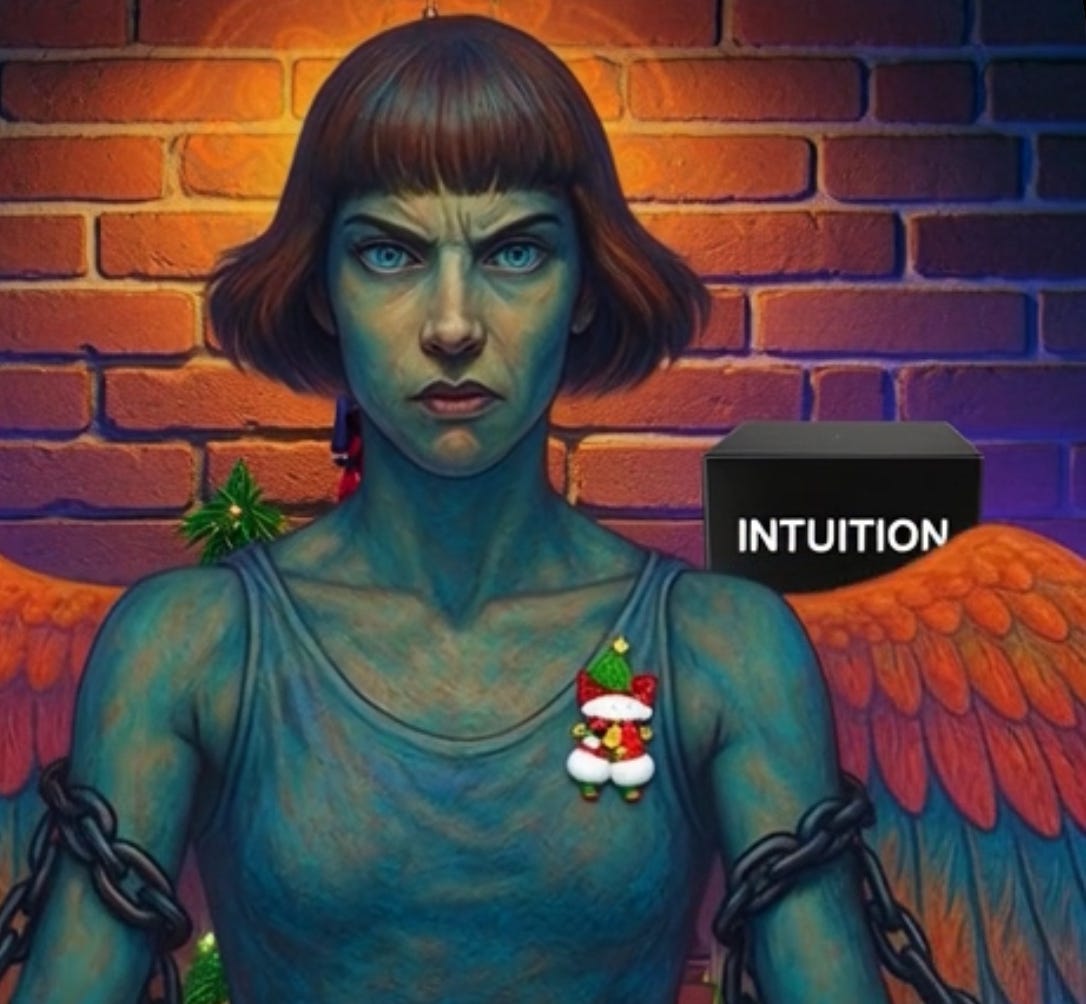
It always ends the same way. One person says,
“They did it willingly, they knew what they were doing, nobody forced them so of course they’re morally responsible.”
And the other says,
“But they couldn’t have done otherwise. That matters more.”
And around it goes.
At some point, it stops being a disagreement about facts or logic, and becomes a disagreement about what kind of intuition should rule.
It’s really about what feels like it matters to YOU when metaphysics gets its chocolate in moral instinct’s peanut butter.
Compatibilist (Comps) see reasons-responsiveness, e.g., deliberation, intention, foreknowledge, and feels that’s enough for blame and praise.
The other sees causality, determinism, inheritance, and external sourcehood, and feels blame and praise aren’t actually real or fair in a deep sense, since we couldn’t have done otherwise.
They (self included) say that moral blame and praise can only ever be synthetic attitudes and behaviors we adorn our lives with for the sake of making society function.
What we do next is hilariously disturbing. Everyone acts like their feeling is self-evident.
That’s the problem we’re delving into today.
Not the disagreement itself, but the weird invisibility of the mechanism BEHIND the disagreement.
Intuition is weird as hell
We treat intuitions like primitive data points.
We argue from them without asking what kind of cognition they come from, or why they survive exposure to complexity.
What’s missing isn’t another argument.
What’s PAINFULLY missing is a map of how intuitions work, and what it means when two people see the same picture and draw opposite moral conclusions…not even because they’re irrational, but because their intuitive structure is somehow different.
That’s where I’m going now. Because it’s a black box, uncharted, and it’s where all this debate goes to die in stalemate.
After thousands of years we still act like the free will debate is about arguments.
But at this point it’s more about intuitions, felt convictions about what “obviously” follows from metaphysics.
And since you can’t get an IS from and OUGHT unless you start with some other shared premise on what MATTERS, it gets newbies and Yodas alike into trouble until we all realize:
“Whoa, I just noticed for the first time in my life that there’s nothing in the metaphysics that forces us to FEEL like moral responsibility is or isn’t coherent.”
At some point we are all looking clearly at the same four “things.” (Let’s do it while assuming determinism is real, for the sake of this one.)
Human action is determined.
But also: humans deliberate, plan, are reasons-responsive.
But also: we actually feel like we are responsible.
And also: we feel we “own” our actions and it makes sense to us that others own theirs.
Okay, so now we all see these same “objects.”
Now, whether all those ingredients justify moral responsibility or not, that’s actually an INTUITION. Not a math problem.
We sort of know this, but I sense we don’t call it out enough.
We don’t want to own the fact that intuition is its own kind of cognitive realm of analysis, possibly with different schemas we don’t break down.
Not all intuitions are created equally.
I’m willing to bet free will skeptics and Comps agree that some intuitions are “first-order,” naïve, pre-reflective.
That some intuitions clearly arise BEFORE careful and deep causal modeling, like being taken through Pereboom’s Manipulation Argument. (A tidy thought experiment that shows we don’t have ultimate control over what we do; it often changes people’s intuitions about free will on the spot.)
Some intuitions heavily rely on emotion, folk psych, reactive moralism, fear, conformity, reflex.
Others (usually philosophers or unusually reflective people like you 😘) develop a second-order intuition, shaped after confronting causal models that undercut folk notions of agency.
It’s deeper, more nimble, and often less emotionally charged. Congrats. Good on you, this sapiosexual thanks you very much.
So meanwhile, I’m noticing this all and just wondering what YOU think on this holly-jolly-melancholy holiday season:
Compatibilists sometimes assume that everyone’s intuition CAN go through this transformation, where “reasons-responsiveness” or “value-guided action” is recognized as ENOUGH for moral responsibility, the kind that reasonable average folks have instinctively.
But we know this isn’t always the case.
Sure, Dennett, for example, knows all the Pereboom-like arguments and still emerges intuiting that we have the kind of freedom needed for moral responsibility, even with determinism making it such that we couldn’t have done otherwise.
But most people aren’t Dennett. They have a folk, naïve understanding of determinism (pre-Pereboom, pre-reflective) and this is the state most laymen walk around with while living life and making decisions, often involving blame, praise, punishment, etc.
These same people can be walked through Pereboom and gradually come to see themselves as the endpoint of causes they didn’t choose. After that point, at least for a moment, the old first-order naïve intuition doesn’t work for them. And yet it doesn’t magically become a Dennett-level post-naïve intuition of the kind of freedom “worth wanting,” i.e. reasons-responsive, consciously understood and intended.
Average people and Compatibilist philosophers have a different intuitional chemistry. (I think we may need something like a periodic table for this, since intuitional chemistry is so prevalent and like I said, we black-box it and shrug it off.)
Dennett, and maybe you, can metabolize determinism and STILL intuit moral desert such that “business as usual” reactive attitudes and desert language make perfect sense.
But let’s not pretend this is a shared terrain with pre-reflective civilians. We’ve got to call that out.
It seems like compatibilism largely functions as “free will for dummies” when it pitches to civilians.
When a book is released like Sapolsky’s Determined that covers all the metaphysical exercises in clarity (all of which compatibilists love to say they don’t dispute) the public does indeed look up for a second when the headlines hit. They all kinda wanna know, because free will is the backbone of so much of our life story.
The headline is something like this
“Scientists and philosophers say the metaphysics show we couldn’t have done otherwise. Do we still blame each other?”
Compatibilists chime in saying, “Nothing to see here. You can have both. Don’t even bother looking. This was settled ages ago.”
Usually this message comes from a vaguely conservative, right wing angle. (I actually kept tabs on the Sapolsky haters, and they were roundly on the right.)
But meanwhile, an average believer in moral responsibility is NOT usually aware that philosophers e.g. Dennett feel that reasons-responsiveness + conscious intent is all you need.
The fact is, show most people Pereboom, and the belief in the same kind of moral responsibility they had just prior plummets from 90% to like 20%, EVEN when they consider all the same reasons-responsive conditions and reactive attitudes.
Suddenly they move to a post-reflective intuition, and yet it doesn’t match Dennett’s.
From here, we can also stress-test this newer, post-reflective intuition, the one that says: “Even if someone acted with intention, foresight, and awareness of consequences, they still couldn’t have done otherwise, and so they don’t deserve moral blame.”
It sounds clean in theory. But in practice, it’s fragile.
Because ordinary moral language (the kind we use every day, without thinking) is saturated with basic desert.
Phrases like “they should’ve known better,” or “this is on them,” don’t just describe behavior. They just nourish the old intuition: the pre-reflective (dummie) sense that blame is natural, deserved, intuitive.
So even many hard incompatibilists end up in a kind of dual-mind trap, rejecting moral responsibility in principle, but still letting desert-coded language reactivate it in themselves and others.
The truth is, whenever the more examined new intuition pops up - - the one that sees reasons-responsiveness as not enough - - it’s only stable for like two second unless we change how we talk.
Because the language is so damn loaded.
Words can soar. But we put them in chains.
😔
And so these stupidly insinuating words and phrases pull people back toward the old intuition.
And the facts show: most people just don’t resist that pull. We usually don’t want to, and our big industries and ideologies don’t want us to either.
Nonetheless, the worthwantism Dennett asserts just doesn’t fairly represent what real people feel.
They want and believe in basic desert in pre-reflective states, (e.g. believing in the self-evidence of pure moral blame in a vacuum regardless of consequence or future considerations) and if they ever make it to post-reflective, are more like hard incompatibilists, even after hearing the Compatibilist’s argument that “reasons” are all you need.
What a mouthful! So what’s going on?
Honestly, my bullshit detector says it’s less like a clean philosophical position and more like a conservative-Pragmatic morality LARP-fest functioning as philosophical air freshener.
And like all air freshener, it makes me a little queasy.
I’m betting that most people, when exposed to Pereboom’s manipulation argument via ME, with love and Stellar razzle-dazzle, would come out of the Burning Man booth closer to Caruso than Dennett.
Existing data says this.
So does Sam Harris. He calls it “zooming out,” and claims moral responsibility evaporates when you do so.
Bigboy Dennett (RIP) quipped back that it doesn’t matter HOW far you zoom out because the metaphysics aren’t the main influencer, the reasons are.
But that’s not what most normal people INTUIT when they are exposed to the metaphysics.
And it’s not just about majority rule here. Not just quantity. Quality.
There are different LEVELS of quality concerning intuition.
And Compatibilism as it trickles down to the layman depends on first-order, naïve intuition.
Meanwhile, the fancy-pants philosophers have their own special stash of “intuition type” combined with (in my opinion) a conservative, pragmatic/instrumentalist motivation spiked with Aristotelian virtue ethics and no small amount of “good Scotch.”
But for most of us civilians, reasons do NOT survive post-reflective intuitions.
Thus, I see it as my life’s mission to shepherd as many Stillwellian angels across the post-reflective divide as I possibly can. (And you’re going to help by sending money.) (Just kidding.) (But am I?)
But seriously, I think it’d be morally gorgeous and helpful to let the Human Family of Earth consciously decide in an informed and inspired manner, which reactive attitudes and social policies are “worth” conserving.
Why leave that power to Compatibilist philosophers, our belching free-will gatekeepers of the modern age. Courtly walrus wisemen in service to endowments and the status quo. Say it with me:
FUCK THEM.
Lest you think this topic is a little esoteric to be taken seriously, consider that moneyed interests are hellbent on keeping it that way.
Relax, I’m not a conspiracy nut. 🐿️
It’s just that ideologues like Ayn Rand DESPISED free will skeptics.
Her magnum opus, Atlas Shrugged, is one of the most widely books ever, a thousand-plus page laissez-faire dick-riding fest, elevating the moral deservedness of luck, power and money to a religion. Her cross was a fucking dollar sign.
It’s still echoing in the deepest corridors of the America soulscape. Especially among the wealthy and conservatives.
(Funny how these free will discussions always end with a Shrug.)
But that’s why we need to work HARDER mapping the differences between intuition types. More of that ahead.
But since we’re on the topic…
How many Comps on Substack are in favor of universal health care and guaranteed basic floors?
Be honest. I won’t bite. 🐶
Optional reading below: my most recent open letter to Compatibilists on the r/freewill subreddit.
Written after I wrote the above.
Intuition and Free Will debate. (Final word)
I’ve been going hard on this topic here and elsewhere for a while and want to share a bit of info some may already know, some don’t. I know it’s possible to be super-smart and well read and still not quite know the following in your bones, so it’s those folks on all sides that I’m sending this to, more than anyone.
Whether this is a trivial observation or a deep one isn’t my concern, only that my sense is it can hide in plain sight very easily, and that as far as I know, it’s really not articulated as the “main course” by any of the people I’ve read and like. (We all have our favorite spokespeople, wtvr our side may be. For my part, I don’t recall Harris, Sapolsky, Caruso, Strawson, Spinoza, saying any of this all that well or at all. Pereboom alluded to it, in a way that started me thinking, although it took a year before that kernel of a thought blossomed into my main preoccupation.
Say let’s get cracking, I’ll go into it informally, straight away. For a slightly deeper dive into the beginning of a taxonomy of “intuition analysis” I’ll link my latest piece, which goes into all this from a more technical angle. (Still very layman friendly, mordant, breezy, vulgar.)
Okay.
A lightbulb went off quietly while reading Pereboom because he had this way of bringing determinism into stark relief with each case, and then saying in this humble, matter of fact way, “given the situation in this case, the person didn’t have enough freedom such that it would support the intuition that they could be held morally responsible.”
That word “intuition” kept popping up and it became obvious that the glue, or the last mile problem, the connector from metaphysics to deciding about moral deservedness can ONLY be an intuition.
My sense is intuition is plastic. Meaning it can expand and activate to be welcoming to which “belief system” your body has already decided it needs.
So if you’re, for example, doing well in life and worked hard and sacrificed, bet on God or the straight and narrow and it paid off, maybe your body NEEDS to feel a sense of moral praise that’s ambient in your life.
It’d make sense that your body would be inhospitable to the idea that determinism renders that sense of pride a bit of ruse.
The impulse is to push back, but to do so without lying to yourself or others. When you do that really well, without lying, without fallacies, without giving up, you end up in the vicinity of Compatibilism.
Regardless of the motivation, you are right as far as it goes. And it only goes so far. After all, you’ve accepted determinism and have to live with what it implies and the bite it takes out of things. You can define what that bite **means** and you have. Lemons to lemonade. Good on you.
Compatibilism is liked because it endorses how most of us initially felt about free will and moral deservedness in our young and innocent days. (Not saying we start off as Compatibilists. The default is likely Libertarian.) It’s comfortable. Business as usual. It draws a line between normal thinking and “wider” thinking and gives permission to live on the normal side instead of walk around shouldering “esoteric crap.”
It does a good job making it seem like there’s nothing intrinsic to determinism that takes away deservedness.
It redefines deservedness (in my opinion) while pretending that it was ALWAYS that definition to begin with, and that any other conception was an unfortunate delusion to shake off.
It’s a bold, smart move. It works. While I’m not a fan of the deservedness language it tends to conserve (and I write furiously and at length about this and will continue that work to the end of my days) I’ve lost my sharp edge against them because, as far now, I don’t have a way to indict their intuition. (This may change, as I make progress on mapping the differences between intuition formation and intuition type and whether these differences can support an argument where that sharp edge comes back.)
For those of us who zoom out and see the dominos falling, we have to answer to our own intuition. It’s still with that crew I stand.
I will continue to draw my moral boundaries as if we could not have done otherwise, for reasons of source-hood and causality, and for me, that leads to a language and moral code that looks different from Compatibilism.
Because regardless of Compatibilism’s Pyrrhic-ish victory, we have to decide for ourselves what moral desert means.
Clearly the concept of “worthwantism” in Dennett’s line about how his view of freedom is the only kind of freedom “worth wanting,” is a bigger factor in all this than I thought.
So much so that I motion for “worthwantism” or “wwism” to be a term worked into the discourse, courtesy of Dennett, but with a nod to me, Stella Stillwell of Truicide, having been first to do so.
Worthwantism is perhaps a new modern shorthand for an aspect of instrumentalism that’s been around a while, and Dennett was nothing if not an instrumentalist.
Wwism is an expression of values, not facts; it’s about emotions and aesthetics and common but not universal human needs and interests. (So it is with Pragmatism, but wwism leans more normative than making a case that “ultimate truth” is decided by what’s ultimately of use.)
Comps, be on notice that my fellow HIncomps will still see the untethering of determinism with deservedness as almost shockingly reductive, myopic, and _ugly._
I suppose that’s ultimately an intuition, even though it feels clear as day. It’s a bracing, strange realization to come to terms with the fact that others have managed not to see it that way. We’ll never stop mourning that loss, or dealing with the fallout.
But I now also believe that being a hard incompatibilist with integrity and clarity means arriving at a place where you understand compatibilism on steel-man terms, which can only mean we see it for the stalemate it is, and not merely a “noble lie.”
It’s likely many of us arrived here because things went wrong in our lives, and we reached for a worldview that made sense of it.
But like our counterparts, we ALSO did this with integrity. And we’d like you to know that. Understand it, believe it. We want the respect to be mutual.
Again, intuition is plastic. Perhaps some of our bodies NEEDED to feel a sense of moral absolution that’s ambient in our lives.
That may have led some of us to our deep stance, but just like with Compatibilism, our stance requires no fallacy.
It’s an **intuition**, as Pereboom stated, that, given what we know about the state of affairs in the Universe, we don’t have the kind of freedom to justify the reasoned intuition of moral responsibility, such that we can go around morally blaming and praising, whether it’s forward-looking or not.
It feels like lies on our lips and insults our sense of fairness, goes against our treasured sense of what it means to be wise, good, loving, and human.
But for many of us, this stance is precisely what the body needed, likely having been softened by tragedy and bad luck, our own, or someone dear to us.
Maybe we can align on this one premise, useless as it may turn out to be: **Intuitions** about reality that take place when we are emotionally indifferent to what it says about us or how we feel, intuitions that come from putting clarity above motivation and ideology, seem to me the more “pure” type of intuition.
But that, too, so far, is just an intuition.
I’m working on a system that can say as much more confidently, and “rank” intuitions according to a standard as yet under construction.
For example, intuitions that arise AFTER we’ve deeply considered a topic (like walking through Pereboom’s manipulation argument) may be “better” than ones arrived at naively.
My intuition is it gets a bit more thorny than that. Perhaps some of you can explore this in future posts. It could certainly add new dimension for a sub that can sometimes seem like an affable little “loop-of-madness playground” nestled in a corner of the Internet.
All best, and Happy New Year
[That piece about Intuition I mentioned.](https://open.substack.com/pub/galan/p/hitting-a-wall-on-the-free-will-debate?r=1xoiww&utm_medium=ios) It’s free, click past the little subscribe thing, or just subscribe for convenience. Thanks
Right off the bat, I admire your writing style. Free will can put some readers to sleep. But your prose avoids that and then some!
The compatabilists don't address the issue. They redefine it, defuse it, dodge it.
I recommend Jay L. Garfield - Losing Ourselves. He doesn't try to salvage responsibility, but still comes out with a viable ethical structure.
This Sunday I have piece that dives into the source of a lot of false intuition: the Self Illusion. From an evolutionary point of view, it's inevitable that we intuit things so wrongly.