
There’s no free will. Now what?

Understanding there’s no free will is simple. But it is not easy.
If you put it so clearly such that people have to confront it, that doesn’t solve the difficulty some will still have in confronting it. What you’ve offered amounts to a quick route to a brick wall followed by a hasty retreat or hazy deflection.
This is almost always what happens with the non-philosophers — those who are not paid to confront these hard truths. But it happens with many philosophers, too, something like 60-80%.
That’s why I was happy to discover Galen Strawson (great name!), a brave philosopher who came up with what he called the Basic Argument, and to my mind it suffices to explain why there logically can be no such thing as free will that warrants basic desert or ultimate moral responsibility.
(Please read the Strawson piece. It’s short, sweet, excellent writing. Would I steer you wrong? A link is here if you want it: https://www.sloww.co/basic-argument-galen-strawson/)
But what we’ve yet to see is a really good, short explainer on what to do with this counterintuitive info once we see it, such that seeing it is worthwhile instead of a nothin’ burger, or worse, a source of anxiety.
What we often get instead of “what to do about it” advice are humble admissions that we can’t do much of anything, we can’t live outside of the persistent illusion of free will and wouldn’t want to. We get these sort of disarming confessions from the Strawsons and Sapolskys of the world that if someone messed with his kid he’d want revenge, too, even though the attitudes of blame and revenge are incoherent concepts in light of free will skepticism.
Or, we get the total opposite: some deeper meditative wisdom on how to bask in the realization, from expert meditators like Sam Harris or Krishnamurti, or Baruch Spinoza, who had deep religious training in prayer as meditation prior to being excommunicated from Judaism, in part for arguing there’s no free will. Ha!
So what now? Heck if I know, but hopefully it occurs to you to at least be nicer to everyone if you can.
After all, without exception we are perfectly and utterly trapped in these subroutines we call lives. Same goes for every famous actor. Every President going back to George Washington. Every comedian or scientist, and all the people who broke your heart, and all those other folks whose hearts you broke.
Some are suffering. Others are doing relatively fine, but most of the luckier ones are nonetheless trapped in a delusion of control, and have been all along — a humbling thought, and unsettling news for the control freaks, which many of the luckier people tend to be.
To varying degrees, most of us are united in this naive indignity. Like toddlers let loose in an old-school video game arcade, tapping away at buttons, steering the silly steering wheel, while the demo sequence loops over and over on the screen. The toddler (bless his heart) thinks he’s controlling the action and doing a great job. He thinks he’s special. (He is, in my opinion, but not for the reason he thinks.)
Meanwhile, the tyke never put a quarter in the slot. He doesn’t have a quarter or any way of getting one. Which is fine because he’s having a blast racking up the points for free. (He thinks.)
But, wait, that kid is not you! — you’re not some dumbass little arcade toddler, you’re hip to the grift, plus you even know that you knowing this truth isn’t due to some virtue all your own. You can’t take credit for how rational and brave you are and you don’t want credit. And you can’t take credit for not wanting credit!
What’s more, you know that it’s not up to you what you do next with this insider info, which is peculiar and where most of us would say okay enough of this philosophical esoteric “fun” and now let’s change the subject please.
But let’s say this Knowing sticks with you under the surface and uses you to fuel unexpected compassion, makes you uncommonly nicer, which is the natural result of you realizing that everyone is ultimately innocent, and equally deserving of dignity and wellbeing.
No big deal, you’re just now one of the universe’s little appendages of electrons that makes other electron-appendage-encased emotional states (or what some philosophers sometimes call qualia) feel less bad and maybe even on occasion happy.
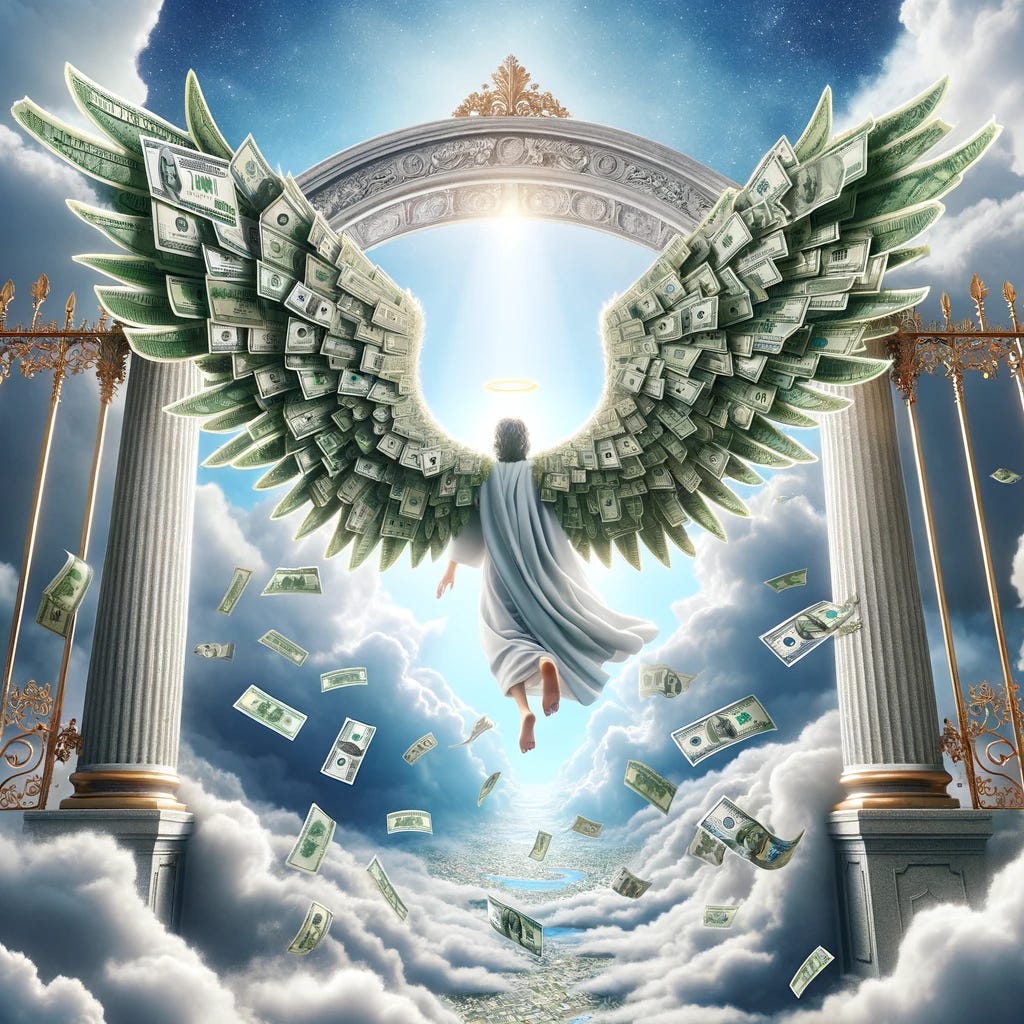
If that’s you, wow, because considering all the pain, fear, ignorance and selfishness in the world, your enlightened awareness and behavior is pretty unlikely, and the closest metaphor to describe you is angel.
So, low key, you’re a ANGEL.
FWIW, not a single word of any of this depends on the supernatural. It’s accurate in a scientific sense, right? Allegedly everything is made of electrons, including you, which makes you a being made of energy vibrations, made of the same fundamental stuff as the brightest stars, a chip off the old Universe, so sort of actually really literally an Angel only even better because you’re real.
If you’re an angel and you know it, clap your hands! There are worse things to be.
For starters, anything else.
😇🥂🎉👊
(Edit: for great insights on what to do with free will skepticism, check out Gregg Caruso, a philosopher who points out in great detail how we can use the rational conclusion of free will skepticism to inspire a more humane criminal justice system without making the world less safe. More on this next time.)
You do some clever writing here and I find it difficult to engage with.
I can only ask myself "Why do I think it matters if people think there is no free will?" I then say "because it can be used as a justification for not caring about what goes on in the world we inhabit together."
...
And while here, I venture to put my radical framing of UBI (even if seemingly off-topic:
It is our money—literally!
Previous generations left the monetized benefits of modern technology to us—every living individual.
=================================================
A radical framing of Unconditional Basic Income:
—Imagine that you are a legal heir of a fabulously rich estate. But on coming of age your Guardian(s) for some reason refuse to sign over full access rights to you.
You would be fully rational in pursuing the matter through legal channels.
—Some words about the assets of the estate:
@transport, rail, road, sea, space;
@vehicles, vessels, space technology;
@energy and extractive technology (mining and electrical energy generation/distribution, use-vehicles).
—These are some of the assets that underwrite the "cost" of Unconditional Basic Income.
The economic and social benefits of UBI have been demonstrated over the past decades by the many pilot programs world-wide.
It is time for politics to yield and implement a universal social security system fit for the 21st century.