
Mind Transfer Without Death
A real method. No copies. No gaps. Just you, moved.

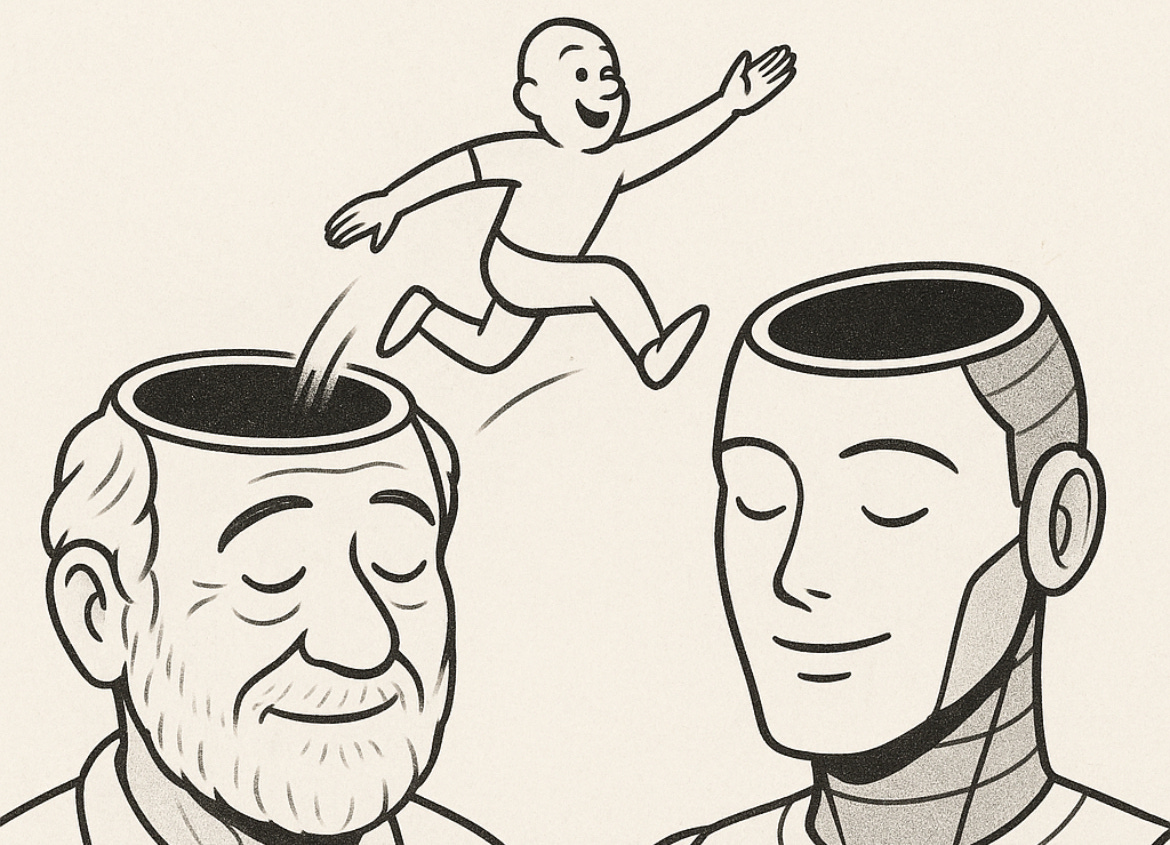
As AI and biotech accelerate, one question moves from science fiction to serious engineering:
Can we move a human mind to a new body without killing the original?
Not a replacement. Not a copy. Not destruction and reconstruction.
A real transfer, where the person stays conscious the whole time. Not a teleportation that kills you. Not a backup of your brain in a server farm, staring blankly at your memories like a taxidermied god. This is something else.
Call it a transfer, sure, but that word is too sterile. What we’re really after is continuity. Not conceptual continuity, but actual unbroken phenomenological continuity. The kind that matters to the person experiencing it. The kind that feels like being you, one breath after another.
Imagine this: Your consciousness, otherwise put as the “lights-on” feeling of you-ness, isn’t housed in the neurons themselves. It isn’t static. It’s an active, recursive electromagnetic pulse, an EMP, shaped by your biology, fed by the loops and firings of your brain. You’re not just your data. You’re the motion of your data. You’re not the riverbed. You’re the river.
And here’s the reason to imagine it:
Because we already know the brain is electric. We know thoughts are carried by charges, that perceptions emerge from oscillations, that awareness lights up not from structure alone but from rhythm. And if rhythm, coherence, and shape are what matter then consciousness may be what happens when those conditions cross a certain threshold. Like gravity emerging from mass and curvature, consciousness may emerge from recursive, self-stabilizing electrical patterns in tight proximity. A standing wave. A moving eye.
And let’s be honest, we still don’t have a satisfying reductionist explanation for that “lights-on” feeling of qualia. (Reductionist in this sense means reducing consciousness to physical processes following known laws.) Nagel describes the hard problem of consciousness as what it’s like to be you.
We talk about neurons, neurotransmitters, gray matter, plasticity. But the brute fact remains: we don’t know how wet, squishy tissue produces a first-person perspective. It’s still the mystery. It still slips through the net. Which means we might be looking in the wrong place. And if so, it could be this. It could be the EMP, the electrical field itself, shaped and channeled by brain tissue, but not equivalent to it.
This isn’t magic. It’s physics we haven’t finished yet. In this view, it’s not that neurons don’t matter, but that what they produce together may be more than the sum of their parts. The EMP may not just be the shadow of the mind, it may BE the mind, in the ways that matter to you, concerning how you relate to your own existence. When you’re objecting that a copy of you living on while you die is unsatisfying because it’s not really “you,” the you you’re talking about may in fact be the actual instantiation of this EMP.
Not merely the map, grid, relations, but the actual EMP itself; pulsing, flowing, doing what electricity does.
Let’s be precise, we are not interested in recreating your EMP somewhere else. That would collapse the whole system of you-ness. What we’re talking about is something far more delicate, and far more possible.
Imagine opening the skull, not to extract, but to entice, to coax the EMP onto a different, more durable substrate. Over days, maybe weeks, nanobot-scale machinery quietly swaps out the substrate associated with a square inch of EMP at a time. Quantum processors, containment fields, and dynamic scaffolds hold the field steady, preserving every flicker, every loop, every resonance, while gradually replacing the studs and joists beneath it.
They don’t stop the current. They don’t even disturb it. They just slide new rails beneath the train without slowing it. Plumbing, wiring, load, all held. Until the EMP, by its own inertia, slips naturally into the silicon lattice without even noticing. Bit by bit, it lives there now.
Now imagine we can move that river.
Not all at once. Not a jump-cut. But bit by bit. One neural cluster at a time, migrated to a new substrate, carefully, gently, like carrying a candle through the wind. You stay awake. You feel. There’s no sudden blackout, no need to trust the machine. You check in with yourself, again and again: “Am I still here?”
Yes. Yes. Still yes.
Until one day, every part of you has been moved. But you never stopped walking. You never stopped being you.
This method is the Theseus Pattern. Not the ship being rebuilt in drydock. Not the paradox of identity through replacement. This is Theseus himself, boarding a new ship while the old one disassembles beneath him, step by step, never once losing his balance.
If consciousness is an emergent property of dynamic, recursive EMPs, then this isn’t science fiction. It’s engineering. And even if it’s not, this method still honors the traveler. It respects the possibility that selfhood is real, and that it deserves to be carried, not simulated. It sidesteps putting us in the difficult position of having to agree to die while a copy of ourselves lives on, and to have to call that the only continuity that matters, when deep down, we know we’d be justifying our own oblivion.
Because in the end, wrong or right or neither, most of us see our true self as a flame that doesn’t survive merely by being copied, but by being kept lit.
Regardless of where that elusive thing we call meaningful selfhood metaphysically resides, it may very well be that mind transfer marketed right means facilitating the UX that Theseus gets to walk across the gangplank, step by step, eyes open, head held high.
We can’t rule this out. Meaning, there’s hope.