
Figure out where you stand on merit.
If you haven’t delved into the whole meritocracy thing you’re missing the plot, luv. Let’s do it together. Message me.

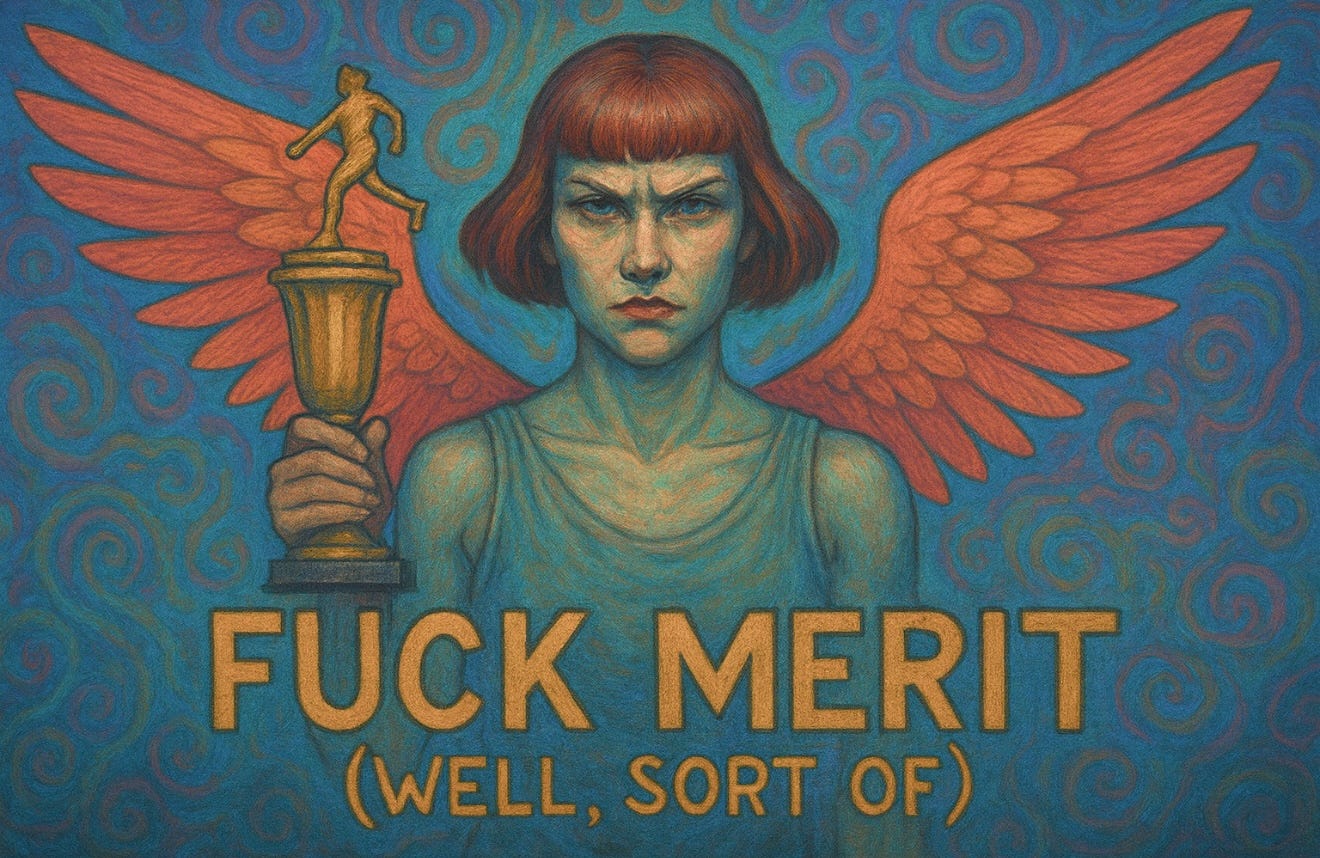
I personally don’t like meritocracy. But merit is real. Let’s get into this: Merit, true merit, implies excellent qualities or excellent performance or actions.
This merit can exist, and it should be bookended by incentive and reward.
(Keep reading or scan down, because after this little setup, I offer a clear breakdown by industry, of how competence isn’t merit.)
WE HAVE TO incentivize merit in people when it helps the survival of the group, and keeps us thriving and safe when we can’t do everything for ourselves. Like cure our diseases, lift heavy things, protect against bad men riding over the hill to rape and pillage us, and so on.
BUT. This sort of merit is a contract, a fact of nature, and we’d be stupid to denounce it or its incentives and rewards. We’re all the beneficiaries of such merit when it’s shared. A remarkable individual’s merit does sometimes lift all boats. It does actually…trickle down. (Gag, I said it.)
But there is no merit in doing harmful things well.
You’ve heard the old idea: “market value does not necessarily equal societal value.” It bears repeating because it’s so often ignored.
If you’re still reading this, you probably agree somewhat that adding suffering competently is no kind of merit worth celebrating. I wouldn’t even call that merit.
But if it’s not merit, what is it? Wasted talent? A misguided sense of worth? Blind performance?
I don’t have the words.
But I know this: competence alone is not merit. For “merit” to merit its name, it should factor in how competence is applied. Regardless of how much revenue it throws off.
Why we reward the strong.
In eons past, the whole point of rewarding the strong was because we had to. We wanted to, we felt we kind of owed them for saving us. Plus, to not incentivize those strong and smart enough to protect is suicide.
But today it’s all turned around. The strong usually don't save us. They enslave and kill us. Most of the great talent and energy is deployed for personal gain. The amassing of wealth comes from doing neutral or damaging things while the majority suffers. Maybe we suffer less than we used to, but we suffer more than we need to, and that’s the only metric that should count.
Let’s see some examples.
FAST FASHION. Behold the environmental degradation it causes, including water pollution, toxic waste, and enormous carbon footprint. Responsible for 10% of the global carbon dioxide emissions every year! All in the name of false validation over an ersatz $5 sequined top made in sweatshops, worn once, and cast into the landfill to leech plastic into our oceans.
MEGA LANDLORDS. Behold the engulfing of entire neighborhoods! Wielding the power to define market values at a whim. In the U.S., 48% of rental units are owned by individual investors — a dominance yielding vast spirals of poverty through skyrocketing rents and unsound living conditions. DEEPENING the homelessness problem! All in the name of unchecked ambition, empires built on backs broken in the desperate pursuit of basic shelter.
BAD FOOD. Behold the processed, the arsenic patina of refined sugar and the menacing fats! Great arching carcinogenic rainbows framing a world where 42% of the population is obese. Meritocrats turn our primal cravings against us. We are manipulating our biology to foster addiction to poison—all in the name of engineered satiety. We are indoctrinating our babies in the ways of immediate gratification at the cost of long-term health.
FOSSIL FUELS. Behold how the burning of black earth-innards makes up 73% of the global greenhouse gas emissions. Take in the climatic upheavals we can no longer ignore. The 8 million premature deaths globally from billows of carbon flatulence. All in the name of convenient energy, trading the breath of future generations for the hum of an engine. Lo! How we all go nowhere, fast.
FACTORY FARMING. Behold the actual living hell of our times. How easily we turn away from these bleating enslaved creatures. 14.5% of the global greenhouse gas emissions come from this marinated purgatory. Overuse of antibiotics run amok, a silent ticking time bomb. All in the name of cheaper meat, courtesy of flesh-trade "meritocrats" peddling umami, putting profit over health, ethics, and sustainability.
PREDATORY LENDING. Behold the tsunami tide of debt cycles (a feature not a bug), the invisible weapon of mass destruction most can't fathom. Complexity is its strength. Fine print and hidden fees bring communities to their knees. In the name of quick gains, clever "meritorious" exploitation for an easy buck at the cost of another's dignity, their life, their soul.
INTENTIONALLY ADDICTIVE TECHNOLOGY. Behold the hijacking of the brain's reward system (perhaps you are beholding right now) and how it leaves us depressed, anxious, and alone. Mega companies creep like icebergs, trillions deep, fueled by outrage and empty validation.
What passes for our "merit" these days.
Those of so-called free market merit have vast castles, galaxies of free time dotted with golfballs and caviar; behold the smirking status, see their sick genes burrow into the wombs of the fittest mates like blinded maggots chewing into forgotten pumpkins.
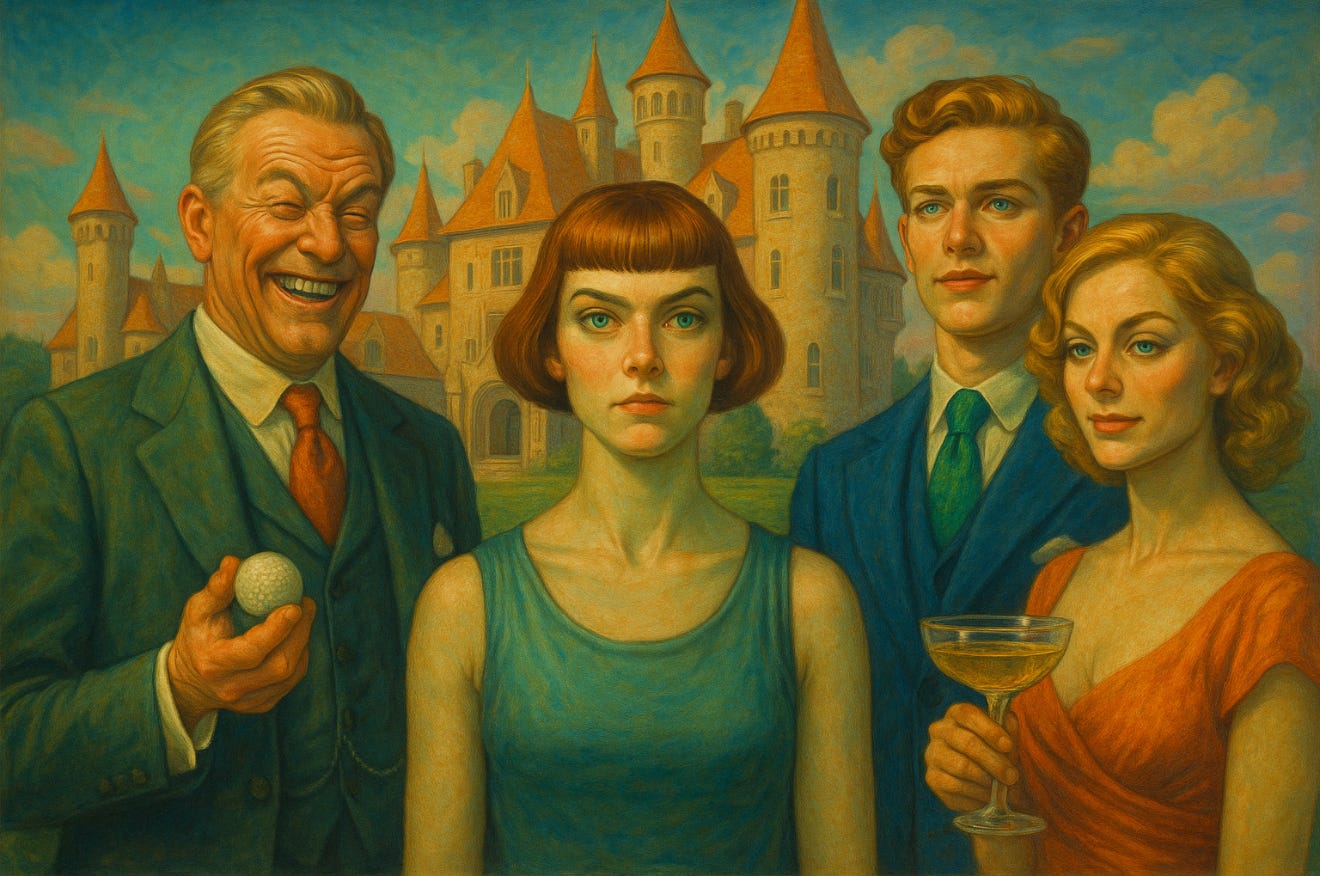
(“Me and the Meritocrats” by Stella Stillwell.)
Watch new meritocrats emerge even more gleaming, succulent, and symmetrical than their forebears. Their hypnotic sapphire and emerald eyes of god, sparkling with smug and empty disgust for the ordinary; a gaze so holy it makes one weep.
But let's pause for a second. Not ALL innovation is terrible.
AI for the public sector has merit, and one who advances it has merit in the true sense. Here’s why:
AI technology can increase production and cure diseases. AI will be copious and easy to produce and own; the public sector will claim enough of it to remove the cudgel of labor from the throats of the masses, enough to undermine the "meritocracy," enough to dethrone those who do bad things.
We can sit and wait. Or we can join the fight. But don’t get me wrong: I don't pretend we have a choice in the matter. Not a real one. I'm not here to blame or to rail against bad character or inaction. I am pointing out the state of affairs, born of causal factors.
This essay itself is born of causal factors: A whirl of particles on an ocean, with priors stretching back to the Big Bang. The echo of a universe trying to heal itself. The frolic electric burp of a black and white cosmos aching to move toward wellbeing and away from suffering. The fulcrum of all that is past in your life and all that's to come, pouring out of these fingertips into our eyes and moving the gears in our brains in unison.
Who knows from whence this proximate song came or how far it shall fly once incubated in our brains and free from the shell? What can we do? What mechanism in us would let these seedlings sink deep into the fertile soil? Can we strain hard enough that these ideas slide like greased wind through the well-tuned harp, picking up new melodies on the way to cosmic mercy?
There's nothing we can do to control the fates. But we try anyway. Try, we must. We will it with all our might, friends, as children with counterfeit telekinesis will the moon's disk to twirl on the mountaintops, splashing lighted hope in all directions to rain into all the dark deserts. Feel it in your electrons, fellow angels.
It is with YOU that I stand. 👊
I like this part: I don’t have the words for “being good at doing bad shit, or being bad at doing the shit you could effortlessly be doing to help others.”