
Making meaning of meaning-making.
Randomly scrolling thru my Substack feed I saw a quote about how nothing is a coincidence. Naturally, I had to pounce on that, but my comment got too long so I made it into this post.

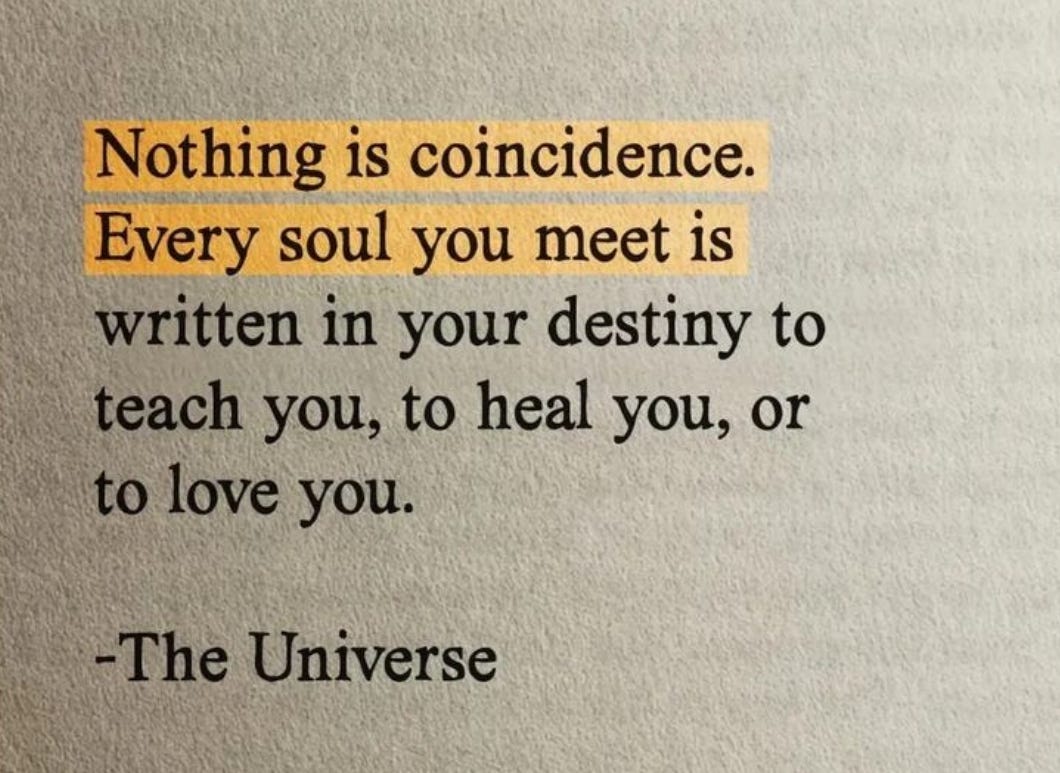
Like a nameless wisp of debris landing on the oily rainbow trapped in the surface tension of a forgotten puddle, I stumbled upon the quote, courtesy of a badass stacker called The Curious Stage. (Highly recommended.)
If you believe that every chance encounter you have is an opportunity to learn, heal, and experience love—courtesy of the Universe itself—then it follows that you’d see life as incredibly meaningful. The “everything happens for a reason” way seeing is the essence of theology. If this attitude makes you happy and doesn’t hurt anyone, I’m all for it.
That said, if you believe that you can turn literally ANYTHING into meaning, that can also be dangerous. If you see everything as an opportunity to turn lemons into lemonade, you may very well be enlightened, but just don’t be surprised when this way of being invites a stampede of unwanted lemons into your life.
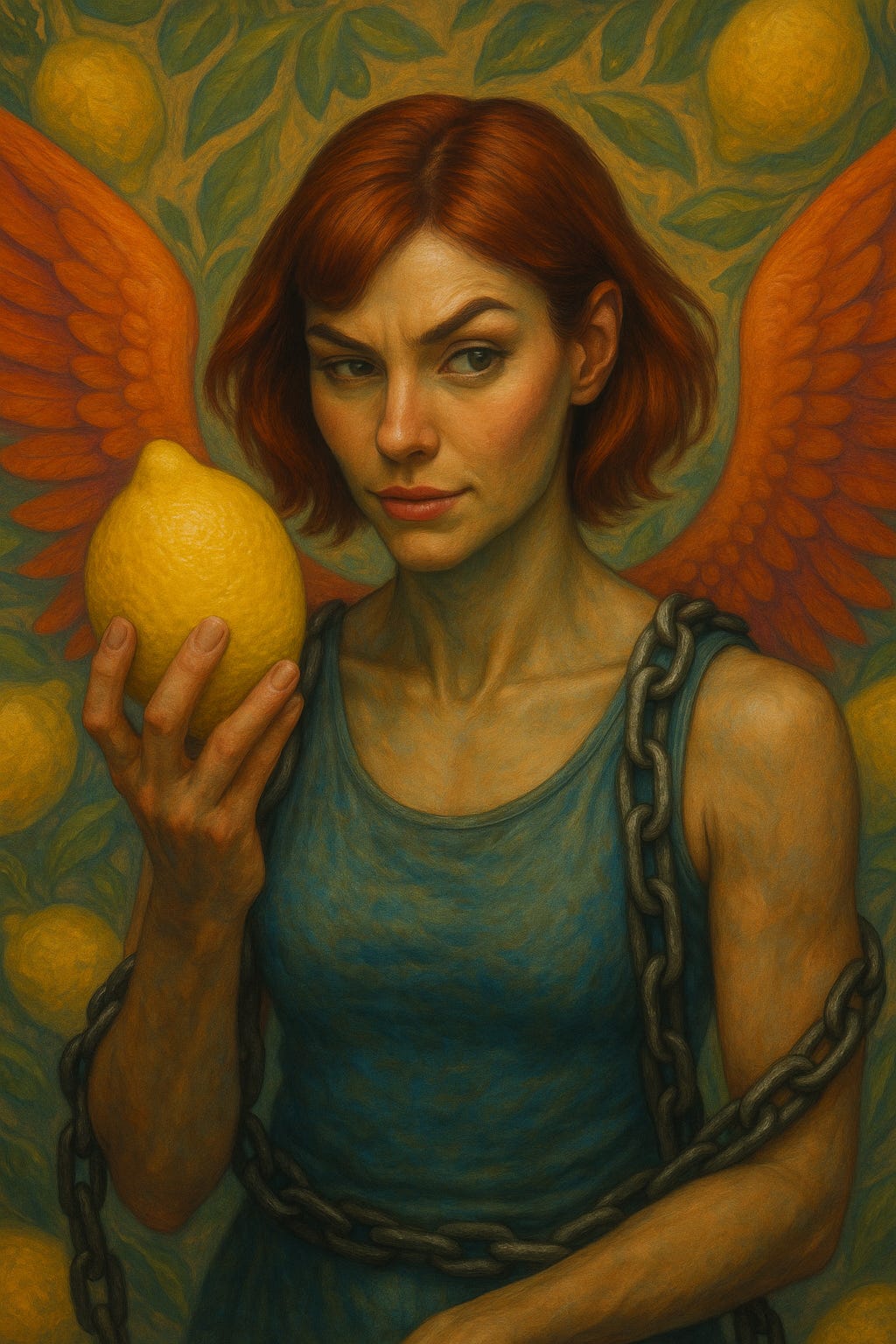
I’m notorious for being the one in my family who can spin meaning from anything. It might sound like a good thing, but it cuts both ways. For example, if ALL things are perfectly serviceable clay for sculpting meaning, you could begin to care less about where we eat, what we do, how to live. It can be liberating, sure, but it’s also terrifying.
Openness to any kind of experience can blunt your drive to get things done, water down your attention to detail. It can make you waste precious time on the wrong things. After all, if everything happens for a reason, there must’ve been a reason you were late, or insensitive, or messy, or whatever other moronic or damaging thing you did.
We can always tell ourselves, in these unpleasant or even harrowing moments that we’re just not looking hard enough, and that it’s actually all good.
Thin is the line between an enlightened sage and a complete fucking idiot.
The idiot sage may even ask: why ever struggle? Why not just coast? We can always spin ANYTHING into meaning later on. So let’s just do what we want.
This may sound extreme, but this reasoning is technically not the slightest bit wrong. Furthermore, some of us are well equipped with the creativity and intellect to transmute literally anything into meaning.
Sure, there’s the issue of long-term consequences. We tend to seek well-being and move away from suffering. We seek positive experiences.
But there’s a massive gray area where being good at finding meaning in odd places makes you evolve into something…weird. This can hurt you and your loved ones over time.
Then there are the opposite types of people, those who are terrible at finding meaning in chaos. Often these are the ones who grab onto ready-made systems and let religion do the explaining.
Or maybe they adopt a secular meaning map and use cognitive distortion to avoid discomfort or change, actively narrowing their possibilities while fetishizing control. When people do that it can unlock profound levels of discipline and what feels like admirable realism. It can even pass for fitness, virtue, heroism.
But often, these people never get the chance to make meaning out of life’s rough edges because there aren’t any jagged, hard-won pieces allowed into their life.
I’m sure the real you has rough edges. We all do. And if someone wants a life without rough edges, it means they want a life without the “real you” in it.
Seems like there’s a catch-22 at play here: When we’re too damn good at integrating the rough edges, and too many of them, they could very well slice us to ribbons. The Universe seems to have a way of knowing who can handle the lemons, and it backs up a truck.
Example: the economy is partly a zero sum game because someone is going to have to do the dirty jobs, and also, some will have to be unemployed who want to be employed. That’s a real economic fact built into the system by design.
It’s how we keep employment opportunities scarce. Which is what employers want, so they can keep wages low while employing the workers willing to do the most work for the least money. This is one of the best ways for owners to get rich. (While supposedly lifting all boats.)
Who better to be the sacrificial lamb at the bottom of our meat-grinder economy than someone who can alchemize toil, sorrow, and deprivation, turning it into great geysers of meaning and poetry?
And who better to sit pretty at the top than those for whom life would be unbearable if it lacked gobs of control, status, and comfort?
The ones who lack the will or the spirit to turn water into wine have to buy the wine at full price. It then usually sits in their obnoxious wine cellar.
To get into that rarified position, it helps to become a master of discipline. To design your life such that you never have to deal with chance encounters or search for silver linings.
It’s not easy or natural to do this, but if you know that your life would be meaningless otherwise, and if you lack the attitude or biology to alchemize meaning from the fabric of existence, it’s a no-brainer. Failure isn’t an option.
Fear of being handed lemons is a great motivator. Just as the ability to welcome lemons with a shrug and a smile is a curse sometimes. Consider this when you ponder how power and control self-sort.
Perhaps you know people who seem like they’ve mastered modern Western life but are childish and stubbornly narrow. Averse to growth, not emotionally present in the messy foxholes with the people they purport to love.

This avoidance is a feature, not a bug. The ataraxia of resourceful cowards thrives on false permanence and a rigid center. It’s good business if you can get it.
Until it isn’t. Let’s face it, no matter how well they have their shit together, it all goes to hell in the end. And when it does, they won’t have the ability to meet that gracefully. And they know it. For now, they paper that over with denial and distractions. And that’s fine, I guess. Not sure what else they could do. We all choose how to give our pound of flesh in this life.
The opposite of the spectrum is no picnic either. If you can turn almost anything into meaning, like a Buddha, traveling like a wave on the ocean, loosely holding your shape while continuously dying in order to truly live, then in the end you’ll have plenty of meaning, sure, but you’ll alienate the people around you.
The spouse, siblings, business partners, or the conservative man-child across the aisle taking away your health insurance, or the fellow liberal more interested in virtue signaling and tribal allegiance than engaging with the messy, unexplored middle meaningfully.
The risks continue: If the cosmos within you says everything is fine—that it all happens for a reason and can all be made holy through alchemy—that’s a dangerous carte blanche.
Because whatever happens, you can say that it’s all stone for the chisel. Blameless, essential, sacred. And ridiculously, the worse it is, the more profound the meaning.
But aside from that being ridiculous, it’s all, again, technically TRUE. It’s an example of pure reasoning that puts stoic ataraxia to shame. Perhaps it’s the truest stoicism there is: the ability to look back and see only necessity, that it couldn’t have been otherwise.
Technically, it could not have been. Blame and regret, or praise and credit, for that matter, are rendered absurd in this light. A light that is really nothing more than pure, unadulterated truth, buffeted by causal logic.
Truth, then, is the ultimate alibi for the mischievous meaning-maker in your life. If there’s a more controversial hot-take, I’ve yet to find it.
It’s hard to resolve, maybe impossible. You might find it disturbing to grapple with. If that’s the case, sorry.
Or you might find it meaningful. If that’s the case, you and I have a lot in common, and I’d love to hear what else you find meaningful.
Yeah I agree, gross is a good word, to find something gross is objective to the individual, but fundamentally it's an aversion to risk as a survival instinct. Within modern society divergence is a risk, the risk is ostracization, which has varying degrees of personal risk including severe risks even in the modern world. Then there is the risk of traversing the unknown as well, the risks there can be just as severe even though they are entirely abstract. So in that way I agree it does feel gross, it's uncomfortable to journey in these liminal spaces of reality because it requires a degree of risk.
You covered a lot of elements here, you tied them together nicely to show how they are just part of a living system. Thanks for the read.