
Why the U.S. won’t tax the rich
And the new story needed to change it

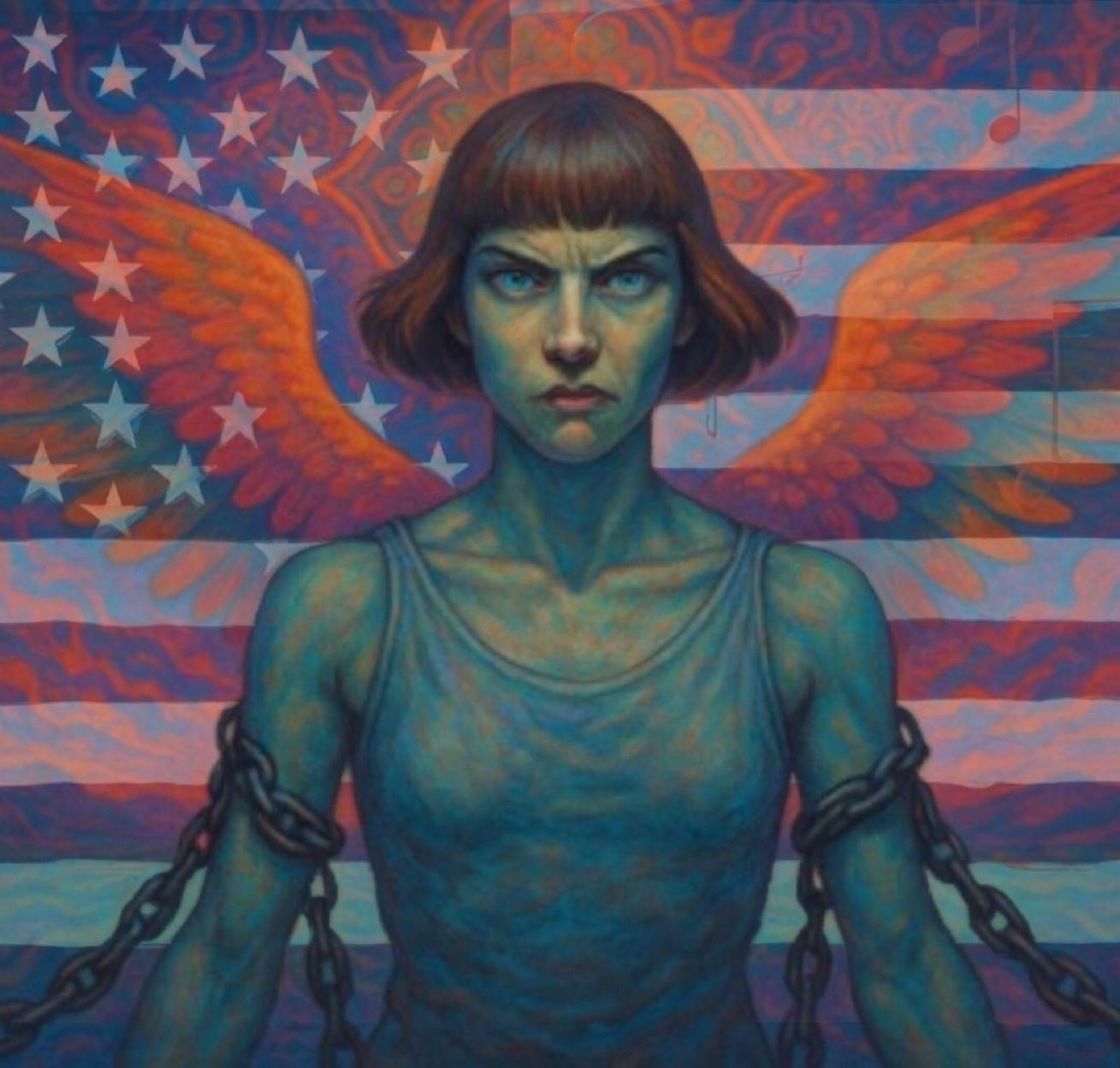
A friend I respect recently said:
“Whoever dies for a preventable medical reason where they can’t afford lifesaving treatment, in the richest country in the world, is arguably a victim of genocide.”
Say what you will, but it’s not a bad prompt for a fruitful discussion.
But then they said:
Those deaths prove Capitalism is evil. We’re reduced to objects.
To that I say:
Yes and no.
Three exhausting words that’ve lit up the darkness since before the invention of fire.
Maybe “yes and no” is the real fire.
So let’s you and me take a shot of whiskey (or whatever passes for relief these days), and cozy up to that fire. Pass it back and forth. See what it lights up. Or just warm our bones. Here we go.
Capitalism
Some capitalism is fine by me. Just not the kind that starts at zero.
I’d say humanity is about done with that shit. Done with the spinning blades of death at the bottom of the hard-mode system that powers wealth from desperation.
When you’re born into a world where every inch of land is spoken for, and every basic need is locked behind a paywall, even if you want to live simply, grow food, skin rabbits, work the soil, you still have to play the game or die.
That’s bullying. And you and I don’t abide bullies.
And a note to the parents out there: if you’re going to bring kids into this kind of world and don’t try to protect them from that bullshit, then as far as I’m concerned, you’re one of the bullies.
Again, so there’s no confusion, we won’t get anywhere denouncing capitalism in its entirety. It wouldn’t even work. We need it alive and well.
Capitalists should be allowed to compete and hoard money all they want, but only after basics for everyone are covered. Call it a pay-to-play system, except the entry fee is a universal basic income.
UBI should happen soon. Either through higher marginal rates, closing loopholes, wealth taxes, or some hybrid.
And for the record, when I refer to “the rich,” I don’t mean your neighbor with a good job or a small business owner who worked their ass off. I mean the top sliver of wealth holders and corporate power brokers who can meaningfully shape tax policy.
Taxes, and who gets to decide
We can’t blame our smart friends abroad who say:
“I don’t understand why Americans are SO reluctant to increase taxes on the rich.”
It’s a fair question. It’s worth taking a beat to answer honestly. Because until we get to the bottom of it, nothing changes.
Because in the end, it all comes down to ONE. SIMPLE. THING.
Taxes.
Strip away the noise, the culture wars, the outrage cycles, the endless spectacle, and that’s the fight.
So here’s why we don’t raise taxes on the rich:
For starters, once the president is elected the citizens have pretty much exercised all the power they have around tax policy.
And here’s a simplistic but true axiom to engrave in stone: The rich are good at riling up enough of the poor to get them to vote against their economic interests.
Much of the rich on the right, including Trump and Musk, based on decades of public commentary, are in private more or less godless, anti-gun, pro-choice, generally-egalitarian, and pro environment. Same for a huge portion of the wealthy, educated Republicans.
BUT if they pretend to align just enough with a large base of white, Evangelical Christian, gun-loving, often racist xenophobes, (and the Latino and black men who overcame adversity but have similar views) then the Republicans can sneak through on wedge issues.
What made Trump valuable to this ideology: he widened what’s called the Overton window, what’s considered acceptable to say and do.
He deploys dual messaging (ambiguous statements that could mean something else) with plausible deniability, and he can do it on his feet, flawlessly. This “gift” lets him pander to the “wedge-issue right” without getting caught definitively breaking the law with incitement, slander, blackmail, extortion, dog whistling, etc.
So there’s that.
Plus a completely obstructionist Congress on the right that shuts down the world before they’d give the left an inch. (This approach really heated up when a black president of regal bearing and winsome integrity took office.)
And once the republicans eke out a win, the president can stack the supreme court, and he and his Congress decide the tax bills that get passed or vetoed.
Most Americans don’t know this until we’re like forty.
Too busy chasing money and status. There’s so much spectacle and distraction. We’re basically taught from the cradle to be selfish and hedonistic. Hoover up elite experiences while we can and go for the gold without looking back.
They definitely don’t teach us how politics works in school, not at this level.
And even if the Democrats could, they wouldn’t word it quite so clearly.
The DNC depends on these same wealthy and corporate donors, and have to thread a strange needle on wedge issues to get enough of the vote.
Because the economic hardship the Dems promise to ease cuts across ideologies, making it tricky to take a firm stance on ANY ideology. Damned if you do, damned if you don’t.
To break the spell, we need an economically left-leaning candidate who can sway the populace like Trump, someone who can carve out new Overton space, but who also doesn’t get too caught up in bizarre far leftist nonsense. That’s why we haven’t been able to raise taxes: we’re waiting for that special someone.
The Left
Some on the far left loudly support policies like allowing trans females to compete in girls’ and women’s sports.
Some defended or minimized riots and looting after the George Floyd killing and resisted arrests.
Some appear overly permissive around youth gender-transition protocols or insist on DEI frameworks that feel quota-driven rather than merit-driven.
STOP.
I have no problem with people debating any of this. It’s America. It’s fair game.
The problem is that the right amplifies the most extreme versions of these positions and presents them as the beating heart of the entire left. That amplification is legal. It’s free speech. And it’s strategically smart.
Never mind that most of those things are tiny footnotes that most on the left don’t care about as much as the economy, healthcare, or war.
Most of these issues aren’t seen as emergencies by the left, but they’re made into them by the right.
Immigration is a biggie.
The situation at the border needs work, the left agrees. But is it quite the emergency it’s being portrayed as by the right?
I’m not prepared to go down that rabbit hole.
The SENSE of the typical center-left voter is that immigrants are not taking jobs that long-time citizens even want.
And that those immigrants keep America functioning and the food and agriculture business booming by doing the dirty jobs nobody will do. For better or worse, part of America’s world-champion GDP includes farm and factory hands; wayward Latinos paying their dues at the bottom of the American food chain.
Not to mention helping obscenely rich builders and contractors that hire talented carpenters and tradesmen by the busload and resell their labor at a 50x profit.
Immigration laws matter and should be enforced. But a lot of these folks are here because our border was porous all these years by design by both parties. That’s on us.
As such, the left largely thinks we owe law-abiding undocumented workers a path to citizenship. It’s a compromise that feels fair and is objectively an economic win for all involved. Just like our Republican colleagues we support a tight border bill; we want to stop fentanyl and criminals from getting in as much as the right does.
Now, the right will amplify all these stories, make news, videos, even documentaries,
trying to convince some of the more easily manipulated white Christian rural folks (not all, obviously) that these stories are HUGE.
There’s a kernel of truth in almost every case. But the name of the game is to magnify and amplify.
Make it feel dangerous, that the black arsonists and DEI crazies are coming for their towns and their jobs. (They’re not.)
And that the “trans crazies” are coming for their kids. (They’re not.)
And that the Democrats are evil communists and that the Clintons and Obamas drink the blood of babies and that Covid vaccines and masks were an evil communist plot to teach blind obedience. (Sigh.)
I think I heard that the Republicans even figured out that they could scare black Americans against the Democrats by convincing them they were getting a different shot as a stealth genocide and ethnic cleansing. (C’mon.) If it’s not that it’s something equally fantastical.
Point is, if there’s ANY way to make the left look crazy and dangerous, godless and sick, deranged and deluded, the right, and the monied interests that serve as its financial lifeblood, the power brokers and king makers at the very top, will exploit it early and often, as much as is humanly possible, with great fanfare and glitz on Fox and wherever else.
Many rich educated conservatives literally laugh at all those wedge issues and couldn’t care less about 99 percent of it.
They’ve assessed the game and how it’s played.
Democracy? Fine. Let’s use free speech to convince ignorant, distracted people to vote against their financial interests. Simple.
And that’s what they do. Relentlessly. Brilliantly. Effectively. And sometimes they win.
Trump
TRUMP was good for them because he can insinuate all kinds of nutso things without actually ever saying the exact combination of words that guarantee his culpability. He’s a master. Plus, his brand and appeal is that he’s a known sensationalist, so people can just say:
“Oh come ON, he’s half serious. Relax. We all know what he means.”
But no, we don’t. He means whatever he needs to mean to whoever is listening. But in simplest terms he’s using freedom of speech to tell a story that gets a majority of people to vote against their financial interests.
He’s good at getting people to vote against their ability to have affordable health care, good education, clean water and air, fair treatment under the law, and solid infrastructure.
A lot of how Trump does this has to do with “god, guns and gays,” and fanning the flames of ignorant racist panic.
That’s the game.
The left plays it worse because they’ve never been quite as comfortable with blatant lying. Not for any moral reason, per se, (they do it when they can) it just doesn’t play as well with their base.
Part of the liberal brand involves a kind of educated, post-racist, post-fear, post-religious emotional and epistemic maturity.
Science, egalitarian, morally enlightened in a vague secular way.
It’s not all bullshit though.
The liberals ended child labor. Fought for women and blacks to have a right to vote and be treated equally. Roped in overtime and slave wages. Fought for safe standards and practices.
And let’s be blunt: the right fought against those things tooth and nail every step of the way. Clear historic record that they fought to perpetuate grotesque cruelty, often under the banner of order or tradition.
That legacy matters, because it’s arguably still happening, and it’s hard to see when you’re living through it. Especially with Trump at the helm, making it more difficult than ever to know what’s happening.
Catch-22
The left really HAS been more humanistic and morally intelligent. By far.
But everyone has weaknesses. The left often goes too far and puts do-gooder stuff ahead of practical financial realities, allegedly.
It’s very easy for the right to make that claim even if it’s not entirely true. The populace have no easy way of knowing. Economics at that level gets too complex to really track.
As such, if the left screws up, overspends a single penny, overplays their hand on idealistic bullshit that can’t scale, the right is all over them.
Magnifying, amplifying, distorting.
To make matters more complex, the right isn’t all bad, either. Nobody ever usually is.
We do need cooler heads sometimes, to balance out knee jerk bleeding heart impulses.
Which is why the government, in its inception, was a beautiful, brilliant thing, allowing for an ebb and flow between these two guiding attitudes. One that puts the general welfare first, and one that makes sure it doesn’t get so carried away that it tanks the whole system.
But we’re now in a late-stage, perverse, cynical place where the extreme techniques these two parties use to compete are tearing apart the country. The techniques, oddly, are legal. Yet they’re not sustainable.
And the side that’s winning never has much incentive to change those legalities while they’re in power.
See the Catch-22?
The right has gotten too good at bullshit.
The left has gotten too coy about denouncing extreme progressive ideas that have been magnified and portrayed as a huge movement.
Ideas are now moving too quickly, and extremism and fanaticism drive clicks and revenue in the short term.
Humans don’t live very long. Short term success matters. In America, success feels like life or death. Given the imperative of status and short-term wins, nobody is going to take the fall to allow truth to reign.
America Loves a Winner
In the pantheon of modern liberal democracies, America is by far the richest country and one of the least happy.
atWe often blame our famous pluralism. But when you look at the numbers, that story is exaggerated. Lots of countries have pluralism and are a lot happier. And they DO innovate.
America is unique in that we turn our status game up to eleven. More than any other country, status is our oxygen. If you lose status, it’s social death. Simple lives, simple dignified jobs, are not allowed. Not if you want to be accepted by your own friends and family.
And the fancy jobs are getting harder to come by. Fail to grab one and keep it, your friends and family will pity you, your mate selection tanks, families crumble.
A typical American will do ANYTHING to stay in the game. Anything. “We just have to make it to 85 anyway. Might as well go for broke.”
Very few people have the simple thought:
“All I really need to be happy is a warm, safe place to sleep and hang out. Food and water, healthcare, phone. Maybe a small veggie garden. And some cool people to play some music with, share life’s chapters, pass the yes-and-no pipe around.
Most of all, I need freedom of TIME, to discover what I’m best at, so that I can do it bravely for the world I love.”
Science is quietly proving that we can be happy without spending so much money, and we can be inspired to innovate without the promise of uncapped windfalls. (See The Happiness Labs and the work of Laurie Santos, PhD. Many others do good work but she always comes to mind.)
But the message is spreading too slowly, too quietly, and nobody seems to want to hear it.
So the fight continues.
Economics
And driving all of it is the simple fact that the rich ones, the ones who could feasibly play the biggest role in shaping the new world, have decided to shape it in a certain way.
They want castles. Guards. Status, jets, the finest of everything. And they want the rabble kept far, far away. Kept busy, hungry and confused. But still powering the money machine from the bottom, grasping desperately for a piece of dignity and freedom.
Once in a while, they let a new member in. But only if it’s an extremely ambitious one carried on the winds of luck. Because such a person will likely buy into the just world fallacy and won’t cause trouble.
This is what they want. Not a happy, healthy human family of Earth. But an almost childish version of old school class systems.
They want yachts on the open water, the wind through their hair, and the feeling that they deserve it, even while U.S. veterans are eating dumpster lettuce.
They believe they are better.
They need us to believe that the very system that lifts them up and crushes so many others is where all the good stuff comes from.
They’ll have you believe that the only way to have medicine, innovation, and lifestyle improvements… is to also have men in super yachts.
But that’s bullshit.
At the foundation of economics are values.
Not equations. Not growth curves. Values.
One side calculates the value of a human life by what it contributes to a free market.
The other side thinks a human life’s value is intrinsic.
That’s the real fight.
Everything else is just noise.
All the talk of debt and deficits, austerity and monetary policy, trickle down and incentive, capital going into new ventures, it’s all deeply misleading.
Go check: right now, the amount of revenue flooding into the top is exceeding the growth of the economy. R is greater than G. (Piketty)
R>G means wealth grows faster than the economy that supports it. Over time, ownership absorbs a larger and larger share of everything, whether or not new value is being created. What we do about that is not an economic question. It’s a moral one.
At the end of right wing economic subterfuge is a simple belief about human life.
What a human is.
And what a human is for.
There are MANY ways to make the economy work. One way leads to more dead innocent humans in the short term. One leads to fewer dead innocent humans in the short term. Both lead to progress.
Long term, we can’t know what the future holds. Only that given a chance to understand what’s at stake, voters might not volunteer to die today in the name of economic theories.
If someone barks high debt and deficit numbers at you out of context, don’t be fooled. The country is not a household. There’s no evidence that investing in a healthier populace today leads to devastating economic woes tomorrow, and plenty of evidence to the contrary.
It’s not about Econ 101 and supply and demand. It’s not the math that differs. It’s the values and ideologies.
One side think value is “proven” by what people will pay for.
The other side thinks that the market maybe isn’t the only way to measure value.
Because after all, there’s a ton of demand for raising kids well, honoring the elderly, cleaning up neighborhoods, proper policing that doesn’t stupidly escalate, health and happiness instead of anxiety and depression. Oh, and not to mention, saving the fucking planet.
But that demand is hard to monetize, so it doesn’t get counted in the ledger by enough voters.
The rich on the right pretend (or perhaps really believe) it proves that demand isn’t there, that those things aren’t a priority.
It’s the same old story and it’s goes in circles. We need a new story that clears up how flawed that premise is. But who’s qualified to tell it in a way that cuts through the noise?
The Rich
The rich aren’t clamoring to help, they have what they want, UBI advocacy isn’t top of mind. We only need a few of them to step up; a few not blinded by the need to feel they deserve their God-like entitlements, or at least are pro-UBI, for the right reason: that once abundance is achieved through automation, capitalism that doesn’t start at zero is the right thing to do.
Meanwhile, the poor and working class? We haven’t thought this far ahead. Between the coping mechanisms, religion, junk food, entertainment, status wars, we can barely see straight. Our bodies know something’s up, but that’s what the meds are for. And that’s that.
Here’s a wrinkle: A few of the kings today are tech nerds. So in addition to the old timey yachts and castles, they also want spaceships.
That’s why we see Musk and Trump working as a team. That’s why tech CEOs are at the inauguration. They have common goals now.
One wants to keep the rabble away from their castles. The other wants to keep the rabble away from the rocket ships and accelerationist technotopian immortality plays.
Some think this approach will lift all boats, and in some messy, imprecise, ugly ways, it can, but at a cost that is rarely weighed by an informed electorate. That’s dangerous.
Meanwhile, the winners in the West are hoarding peak experiences while millions suffer needlessly, and regardless how they feel about all that, they tend to agree on one thing: money belongs at the top and taxes on the rich should be kept low.
They want the bottom grinding in hard mode, with as little state help as possible, because that grind is the dirty fuel that moves the machine from the bottom.
They aren’t evil. They have a right to their opinion and values, and free speech.
And in fairness, they don’t ALL take quite such a hard line. Buffett, Gates, Cuban, Dario Amodei of Anthropic, and more, have suggested raising taxes and closing loopholes.
So on Election Day, whoever wins does so fair and square.
How do we turn the tides?
Someone has to tell a better story.
It has to resonate with more people. Cut past the fear, ambition, selfishness, religious fervor, addictions, pride, misinformation, the war on empathy, boredom, paranoia, echo chambers, ignorance, status games, fierce grudges, the ticking clocks of mortality, and all kinds of hate—some taught, some hard wired, if we’re honest.
Someone has to tell a simple story that paints a picture of a better way. Names what a human is, and what a human is for. Awakens something deep inside that’s sick and tired of all the bullshit, and ready to be a human family of Earth.
Not communism. But Capitalism that doesn’t start at zero.
Not avoidance of wedge issues, just a clear acknowledgement that while they matter, they don’t matter as much as poverty, disease, war and sustainability.
The story needs to make sense to average people.
When we figure out what it is, it can be spread easily, carried by the wings of free speech and accurately-counted votes.
So. Who’s it gonna be?
Who’s going to tell this new story?
I personally think it should be you. ❤️
My opinion is as following. Most countries tax 40% of national income. In the US it’s 35%. 20% is spend mostly on retirement or retirement like payments 5% on education 10% on healthcare 5% on infrastructure military and the sorts. In the US it’s 4% on the military with way less spending for healthcare education and retirements.
You can tax in 2 basic ways. 55% of GDP is produced by labor 45% by capital income, rents stock dividends and so on. Let’s simplify it 50/50. I think a 25% income tax is fine, but in practice it’s way more in most countries. And a 25% cooperate tax rate and rent income rate is fine too. Now you have taxed 25% of GDP.
Then I would additionally tax stuff that causes bad health. Booze, cow meat, cigarettes, sugar, soft drinks by an special value added tax of 50%. Luxury goods should be taxed too. Single household houses exceeding 400 square meters, yachts, expensive watches, escorts and prostitution, gambling, cars exceeding 100K USD should be all taxed high. Because whoever can afford that does not need more cash. That will make 35% of GDP more or less. Like the amount of taxes the US taxes from citizens.
Now the spending side should be I think as following 10% of GDP should be UBI. 5% of GDP should be rewarded to parents of new born babies. 5% education, 5% infrastructure, 5% healthcare. Basically by adopting Japans healthcare system. The remaining 5% can be military and other public spending. And 5% should be research and development because at the end technology creates wealth.
Concerning rich people I think they do an important job by allocating capital efficiently. But beside a 1% wealth tax I think the best way to tax them is to tax luxury goods because those goods harm people, they are inefficient and lead to very less utility per dollar spend
Stella,
I resonate with your instinct that the fight is not ultimately about math, but about values.
Where I find myself wondering is not whether we should tax the rich more aggressively — that’s a policy conversation worth having — but how we preserve the trace of how we got here without collapsing into moral compression.
When inequality rises, it is tempting to treat people as villains first and gradients second. But I’m increasingly persuaded that people behave more like water than like archetypes. Water flows where the landscape directs it. If extraction dominates, it may be because we optimized the terrain for extraction — not because everyone at the top is uniquely corrupt.
You’re right that slogans move people. But slogans also compress. “Tax the rich” may mobilize energy, yet it risks flattening the difference between:
high earners paying substantial income taxes
asset-heavy ultra-wealth using debt leverage
institutional incentives that favor capital gains
campaign finance structures that shape legislation
Those are different gradients.
When we compress them into one moral token, we lose resolution. And when resolution drops, oscillation increases.
I don’t think the question is whether capitalism is evil or redeemable. I think the question is: what landscapes are we shaping, and what gradients are we rewarding?
If we preserved the trace of policy drift over decades — tax code revisions, campaign finance shifts, bailout structures, regulatory capture — we might argue less about who is evil and more about which gradients persist and why.
That feels upstream of taxation.
You’re right that a better story is needed.
I wonder if that story is not about punishing extraction, but about harmonizing emergence.
Not revolution.
Not moral purity.
But raising the resolution of how we see each other, so that reform does not require annihilation.
Anything alive, as I’ve come to believe, can’t be created alone.
https://thesacredlazyone.substack.com/p/anything-that-is-alive-cant-be-created
Maybe policy can’t either?